Top ecommerce trends for 2023
There are several ecommerce trends to watch out for in the coming year. Here is a brief overview of the trends we should be paying attention to:
1. Mobile commerce
Enabling customers to shop via mobile devices is no longer an exception but a new norm. According to statistics, mobile devices account for 61% of retail traffic, with 70 million online users shopping via mobile devices. This figure will definitely increase, so we are convinced that mobile commerce will be one of the major e-commerce development trends shaping the future.
The reason is simple and clear: mobile shopping is convenient. It allows customers to shop from anywhere, which is essential in today's world. Customers can simply research, compare products and make payments on the go.
2. Rise of the "Marketplaces
Marketplaces provide a simple paradigm for multiple vendors to collaborate on a single system to handle everything, making it easier to reach specific groups of people and address specific problems. This model will become more popular in the coming years. According to Forbes, marketplace sales will exceed $3.5 trillion by 2024.
3. Customization
Personalization will undoubtedly play a key role in the development of personalized e-commerce in the near future. According to statistics, more than 60% of consumers are more likely to become repeat buyers if a company offers a personalized shopping experience. Consequently, we can expect an even more significant shift towards personalization, especially in relation to search experiences.
On-site search personalization refers to tailoring search results for each particular customer according to their previous behavior on your site, profile data and many other aspects. Using search engines such as Elasticsearch or Algolia, for example, you can make suggestions about what search results your customers expect to see as they type their search queries.
43% of customers use site search when making a purchase, so investing in this can be a crucial source of making information accessible throughout your site and retaining more customers.
4. Artificial Intelligence (AI)
Most cutting-edge technologies, such as intelligent chatbots, personalized product recommendation engines and voice search, use artificial intelligence (AI), and will become essential to the e-commerce industry in the coming years. With 70% of online business owners believing that AI for e-commerce will help them personalize their online stores, there is no doubt that this technology will continue to grow.
Voice-activated payments, virtual conversations and voice searches are the most common uses. In addition, machine vision enables face detection and identification. During a purchase process, chatbots employ deep learning algorithms and NLP (Natural Language Processing) to capture the human speech and words of the other party.
5. Augmented Reality (AR)
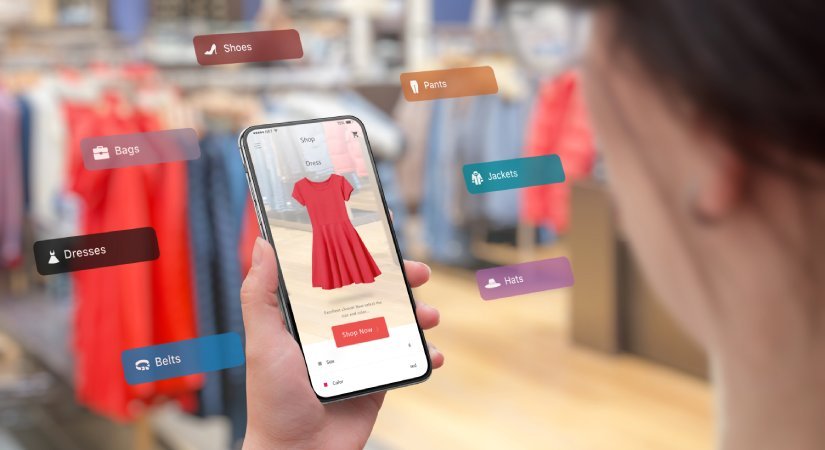
Augmented reality (AR) is a real game changer in e-commerce. Statista estimates that the augmented reality industry is worth $30.7 billion, with more than 400,000 AR glasses sold by 2021.
This technology uses 3D mapping to allow customers to try things on or preview experiences before they buy. What challenges does AR commerce solve? It enables you to offer a more intuitive and engaging visual shopping experience that allows customers to interact with products in an immersive way. As a result, AR technology enhances customers' ability to visualize products before they buy and make more successful purchases.
That's why we expect many more companies to use AR for their products and services, especially in specific industries, such as fashion and home décor, because the customer can get a better idea of the item without seeing it in person.
6. More ways to pay
69.8% of shoppers abandon at some point between filling their cart and checking out. Let's face it, typing in a credit card number isn't the most user-friendly experience. That's why offering more methods to receive online payments may soon be in demand.
If customers can't pay the way they want to on an e-commerce website, there's a good chance they'll cancel a potential sale. Offering a range of payment options is an excellent approach to boost conversion rates. Plus, if customers can save their payment information on your website (and this process is protected), they will be able to pay faster the next time they make a purchase.
Consumers are rapidly adopting new payment methods, with 93% saying they would consider emerging payment methods such as biometrics, digital currencies and QR codes. Among the most widely used online payment gateways are PayPal, Amazon Pay and Apple Pay.
Another growing payment method is cryptocurrency. While this is still a very new trend, it is difficult to predict what will happen next. However, several major players, including Microsoft, Starbucks, PayPal and Tesla, are already accepting cryptocurrencies as a payment method. In addition, 40% of consumers would like to use cryptocurrencies next year.
7. Sustainability and remarketing
52% of consumers worldwide admitted that the pandemic has made them value sustainability issues more. In addition, a survey found that nearly 80% of customers consider the sustainability of the retail product or brand when making purchases.
What exactly is remarketing? Re-commerce (resale or reverse trade) is the buying and selling of new or used, previously owned items. Buyers are increasingly looking for items and companies that match their environmentally conscious attitudes. Brands are already reacting to this. Zara, for example, wants all its brands to use fully organic, sustainable or recycled materials in their clothing by 2025. Smaller B2C brands are also on the same trend. Retailers are making a significant contribution by focusing on sustainability. At the same time, this allows them to establish long-term connections with their consumers and, at the same time, reach new audiences.
8. Omnichannel customer experience
Many companies plan to prioritize omni-channel in the coming years. In fact, with rising customer acquisition costs (CAC), this can be extremely advantageous. According to a recent study, 32% of brands want to expand their in-person interactions by 2022, for example, by opening pop-up stores or putting items in POS.
Customers expect to be able to easily switch between platforms and devices when making a purchase. A recent study shows that 69% of shoppers said they expect a consistent experience across all channels. A personalized shopping experience is not just about one mode of communication. To successfully personalize, marketers must focus on delivering a consistent experience across many platforms.
We are also witnessing a significant increase in showrooming and webrooming. Showrooming takes place when a person visits a physical store to inspect things before buying online. Webrooming is the opposite, with customers browsing online before buying in-store. With 54% of consumers engaging in the showroom and 59% using the webroom, companies interested in experimenting with these should focus on creating a consistent experience across all channels.
9. Social commerce
Buying and selling things or subscribing to services directly through social networks is known as social commerce. Unlike in the past, when social networks were used exclusively for marketing, several of these platforms now have integrated technology that allows people to buy things directly through their applications, for example, Facebook and Instagram Shops.
In addition to allowing social networks to become a direct sales channel, social commerce involves advertising items on social networks increasing interaction. In addition, consumers can now get information, advice or comments on things right where they buy them.
The social commerce industry is expected to grow steadily by 22.8% during 2022-2028. According to a recent estimate by Accenture, social commerce will expand three times faster than traditional e-commerce solutions, far outpacing $492 billion in 2021 to $1.2 trillion in 2025.
Currently, Pinterest, Instagram and Facebook have their own tools for buying and selling things, and TikTok has introduced TikTok Shopping. With these rapid updates, more businesses will use social commerce to influence customers' buying decisions, giving them greater visibility and higher conversions.
10. Live shopping
Many people were forced to find new ways to make a living as a result of the pandemic. Successful business owners have recognized the advantages of using live video to sell items and interact with consumers.
According to McKinsey, live commerce sales could account for up to 20% of total e-commerce by 2026. While live streaming was once just a fun feature for social media users, it is now becoming one of the vital e-commerce solutions. We anticipate that live selling will become a prominent trend in the next decade for small businesses that are still looking for potential customers.
Technology and people are always moving forward, and because e-commerce connects them all, we must always look ahead. As you can see, the landscape is becoming more competitive. Customers are now in charge and e-commerce companies are adapting to meet their needs.
Adaptability to changing market conditions is essential today. However, not all trends are worth following. Some trends may be useful, while others may be irrelevant to your audience. Before making any decisions, it is important to evaluate the details of the project, analyze user feedback and focus on future goals.