In the age of information and Artificial Intelligence, Internet access has become a crucial indicator not only of socioeconomic development, but also of a country's social progress. In Latin America, the digital divide remains a significant challenge, with large disparities between nations in the region. This analysis is based on recent data showing the position of several Latin American countries in terms of Internet users, while exploring the broader implications of this gap for social development.
The Importance of Internet Access for Social Progress
Before analyzing specific data, it is crucial to understand why the proportion of Internet users in a country is a key indicator of social progress:
- Access to information and knowledge: The Internet provides immediate access to a vast amount of information and educational resources, enabling people to learn, improve their skills and stay informed about local and global issues.
- Improved education and learning opportunities: The availability of online educational resources reduces educational barriers and promotes a more educated and empowered society.
- Economic development and job opportunities: Internet access opens up opportunities in the digital economy, stimulating innovation and contributing to economic growth.
- Social inclusion and reduction of inequalities: The Internet facilitates communication and connection between diverse communities, promoting social inclusion and cohesion.
- Access to essential services and improved quality of life: Through the Internet, people can access online government services, health information, financial services and other facilities that improve the quality of life.
Analysis of the Digital Divide in Latin America
Digital Leaders
According to data from the International Telecommunications Union (ITU), published by the World Bank, Chile and Uruguay top the list in Latin America, ranking 35th and 36th respectively among the 170 countries evaluated worldwide in the Social Progress Index. With Internet user rates of 90.19% and 89.87% respectively, a large part of the population in these countries has access to the educational, economic and social advantages offered by the Internet. Although they are still far from the top 10 in the world, which have percentages above 97% of Internet users.
Argentina follows closely in 42nd place, with 88.38% of Internet users; along with a group of countries in intermediate positions such as the Dominican Republic (position 57), Costa Rica (position 68) and Brazil (position 72), with Internet user rates between 80% and 85%.
These countries are in a promising position to take advantage of the social benefits of the Internet, but still face challenges in achieving universal connectivity. The remaining gap may be affecting mainly rural or marginalized communities, limiting their access to online educational and economic opportunities.
In the middle of the table are countries such as Mexico, which despite being one of the largest economies in the region, is in 86th place with 75.63% of Internet users. And Colombia, in the 90th position with a percentage of 72.8% of Internet users.
At the lower end of the list are countries such as Nicaragua, Guatemala and Honduras, with internet user rates below 60%. These countries also have some of the lowest GDP per capita in the region, underscoring the relationship between economic development and digital connectivity.
A particular case is Panama, which despite having the highest GDP per capita of the countries listed ($33,266), ranks 101st with only 67.51% of Internet users. This could indicate an unequal distribution of wealth or a lack of investment in digital infrastructure, which limits the social benefits of economic development.
This low connectivity poses serious challenges for social progress in these countries. A large part of the population could be excluded from the educational, economic and social participation opportunities offered by the Internet, perpetuating cycles of poverty and inequality.
Table 1. Internet users as a percentage of the total population.
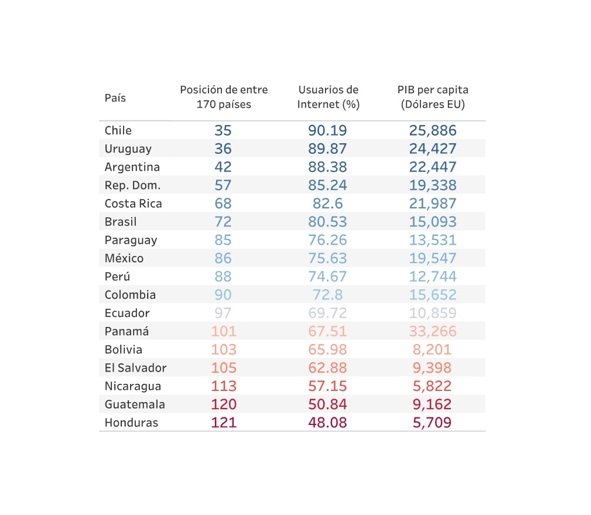
Source: IPS 2023 with ITU data.
Pathways to follow
The digital divide in Latin America not only reflects existing economic inequalities in the region, but also has the potential to exacerbate them. While countries such as Chile, Uruguay and Argentina show a path towards a more connected society and thus greater opportunities for social progress, others struggle to provide internet access to large segments of their population.
Closing this gap and promoting more equitable social progress will require a concerted effort by governments, the private sector and international organizations. Public policies should focus on:
- Investment in digital infrastructure, especially in rural and marginalized areas.
- Digital literacy programs and digital inclusion policies for all ages and groups in society, ensuring that people not only have access to the Internet, but also the skills to take advantage of it.
- Incentives for the adoption of information technologies in small and medium-sized enterprises, promoting economic development and job creation in the digital economy.
- Regional collaboration to share best practices and resources, recognizing that digital progress in the region benefits all countries involved.
- Development of relevant local content and online services that respond to the specific needs of Latin American communities.
Bridging the digital divide in Latin America is not only a matter of equity in access to technology, but a fundamental strategy to promote comprehensive social progress in the region. As the world becomes increasingly digital, ensuring equitable access to the Internet and its benefits becomes an imperative for building more just, educated and prosperous societies in the 21st century.