In the context of the Paris 2024 Olympic Games, we analyzed some data to try to find the keys to the success of countries in the Olympic Games; understanding that the road to Olympic medals is not based solely on individual talent, athletic training or sports infrastructure. An analysis of the social conditions of countries reveals that social progress plays a crucial role in a nation's ability to excel on this global stage. This text briefly explores the fascinating relationship between social progress, economic factors and Olympic success, offering a valuable perspective for a Latin America that can be consistently successful in the games.
The connection between social progress and Olympic medals
In an exploratory way we looked for the correlation between Olympic medals per capita and the Social Progress Index (SPI), which measures a country's performance across 12 social and environmental components and 57 indicators for 170 countries. The medal data considered covers the total medals won by each country in the Summer Olympic Games from Helsinki 1952 to Tokyo 2020, while the SPI data comes from the 2023 index; while population data was obtained from the World Bank and used to calculate the number of medals per capita; and purchasing-parity adjusted gross domestic product per capita.
In our analysis of Olympic success, we chose to use medals per capita as the primary metric for two main reasons. First, this approach allows for a fairer comparison between nations, as a simple count of total medals can be misleading by not taking into account population differences. Countries with larger populations naturally have a greater number of athletes and thus more opportunities to win medals. By considering medals per capita, we level the playing field, allowing for a fair assessment between large and small countries. Second, this metric reflects the efficiency with which a nation uses its resources to produce elite athletes. A country that achieves numerous medals with a small population demonstrates high efficiency in identifying and developing athletic talent, which is a valuable indicator of the effectiveness of its sports programs and social development policies.
Key results
Our analysis reveals a significant positive correlation (0.513) between the overall Social Progress Index (SPI) and Olympic medals per capita, suggesting that countries with higher social progress tend to achieve more Olympic success relative to their population. This relationship is clearly illustrated in Figure 1, which shows the distribution of countries according to their GPI and their Olympic performance. The IPS components most influential in this sporting success are Inclusive Society (correlation of 0.529), Advanced Education (0.518) and Personal Freedom (0.496), all belonging to the Opportunities dimension of the IPS, which focuses on the capabilities and freedoms that enable individuals to reach their full potential.
Importantly, although GDP per capita shows a moderate positive correlation (0.337) with medals per capita, this relationship is less strong than that observed with the GPI components. This suggests that while higher income levels are associated with better Olympic performance, they alone are not sufficient to guarantee success. In other words, social progress, especially in areas that foster inclusion, advanced education, and personal freedoms, appears to be a more important determinant of Olympic success than a country's sheer economic power.
Relationship between GPI and Olympic medals per capita (1952-2020).
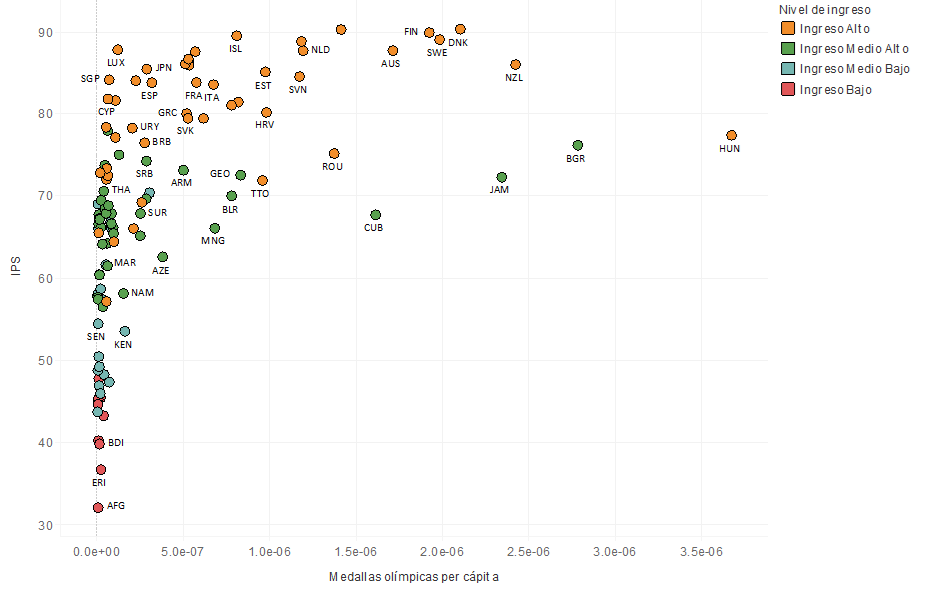
Source: Own calculations with data from the Social Progress Index, World Bank, and the International Olympic Committee.
Examples of high and low performance
Highlighted countries
- New Zealand (GPI: 86.06, GPI ranking: 14, ranking in medals per capita: 3)
- Denmark (GPI: 90.38, GPI ranking: 1, ranking in medals per capita: 5)
- Sweden (GPI: 89.09, GPI ranking: 5, ranking in medals per capita: 6)
These countries excel in both the GPI and per capita medals, with high scores in the opportunities dimension.
Countries with opportunities for improvement
- Qatar (GPI: 69.29, GPI ranking: 65, ranking in medals per capita: 42)
- Panama (GPI: 72.10, GPI ranking: 55, ranking in medals per capita: 70)
- Mexico (GPI: 68.49, GPI ranking: 69, ranking in medals per capita: 75)
These countries, despite having medium or high incomes, show low per capita Olympic performance, consistent with their low performance in the opportunities dimension.
Of course, there are also "outliers", countries that have prioritized the Olympic stage to promote their governments, such as Cuba, which for its level of social progress (GPI: 67.78, GPI ranking: 74, ranking in medals per capita: 15) has a high Olympic performance. Or Jamaica, which by taking advantage of the natural talent of its sprint athletes has positioned itself as one of the most successful countries in the Olympics (IPS: 72.36, IPS ranking: 54, ranking in medals per capita: 4). But, not counting outliers, the general trends show that certain conditions of collective well-being are needed to enhance the country's sporting talent in high-performance sports and at the Olympics.
Implications
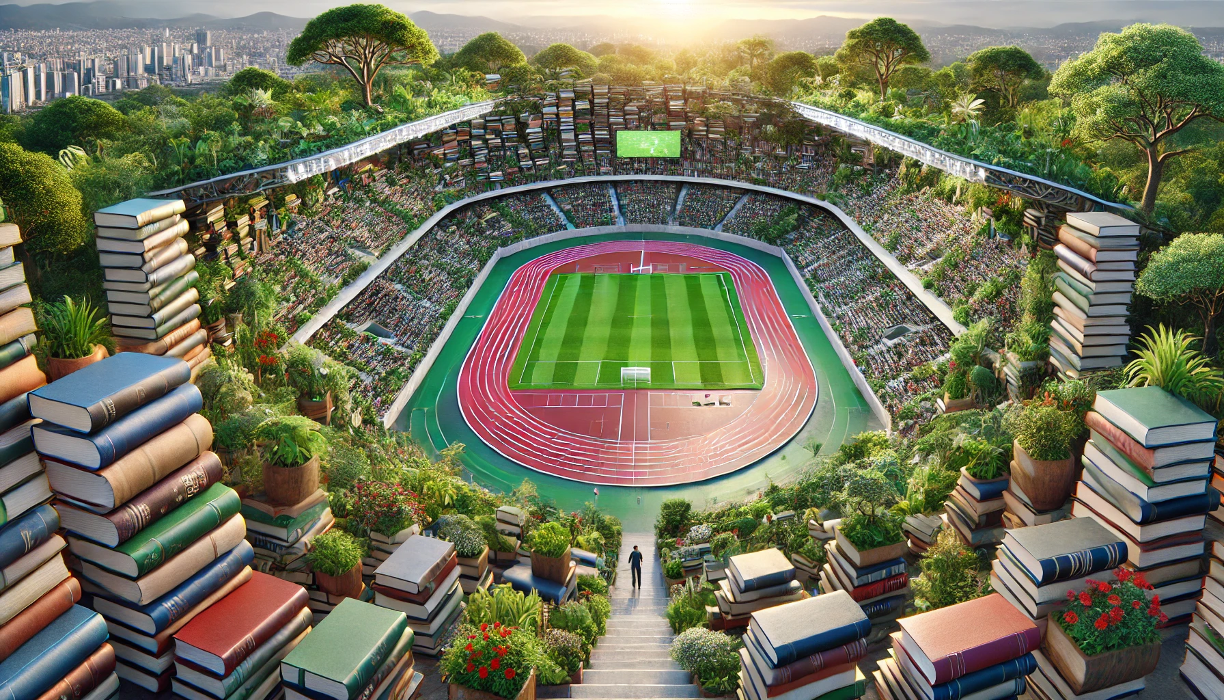
Finally, the data analyzed suggests that a country's Olympic success is more likely when it has an environment of opportunity where people can reach their full potential. This approach encompasses the creation of programs that foster social inclusion and ensure equal opportunities in sport, investment in advanced education, and strengthening the linkages between educational institutions and sport programs. Although the correlation between these factors and Olympic success does not imply direct causation, it does suggest that social progress creates an environment conducive to the flourishing of athletic talent. The path to the Olympic podium begins in classrooms, in inclusive communities and in societies that value freedom, creating a virtuous circle that not only enhances athletic performance, but has the capacity to elevate the quality of life for all citizens beyond a four-year Olympic cycle.