- Costa Rica drops 7 positions in the index
- Ranked 62nd out of 141 countries
This October 9, the results of the Global Competitiveness Report 2019 were released, for the second consecutive year using the methodology focused on the fourth industrial revolution, and which seeks to measure how prepared countries are to take advantage of the benefits and face the challenges of this revolution.
According to the 2019 Global Report that was launched today in Geneva, Switzerland, Singapore is the most competitive economy of the 141 countries evaluated, followed by the United States and Hong Kong. The United States loses its leadership and Hong Kong gains 4 positions. In Latin America, the leadership is held by Chile, followed by Mexico and Uruguay.
Costa Rica is positioned as the fifth most competitive country in the region in position 62. Among the strengths of the country, the report points out that in the areas of infrastructure, health, skills and products, Costa Rica is positioned higher than the Latin American average.
Despite the country's strengths, Costa Rica faces considerable challenges to take advantage of the potential of the fourth industrial revolution. Among the most critical areas is the adoption of ICTs, as we have few subscriptions to fiber optic internet and fixed broadband. In the area of innovation capacity, we are lagging behind the best in the world due to the lack of recognition of research institutions and scientific publications. Another critical point is the financial market due to the little financing given to SMEs, availability of venture capital and the little development of the capital market.
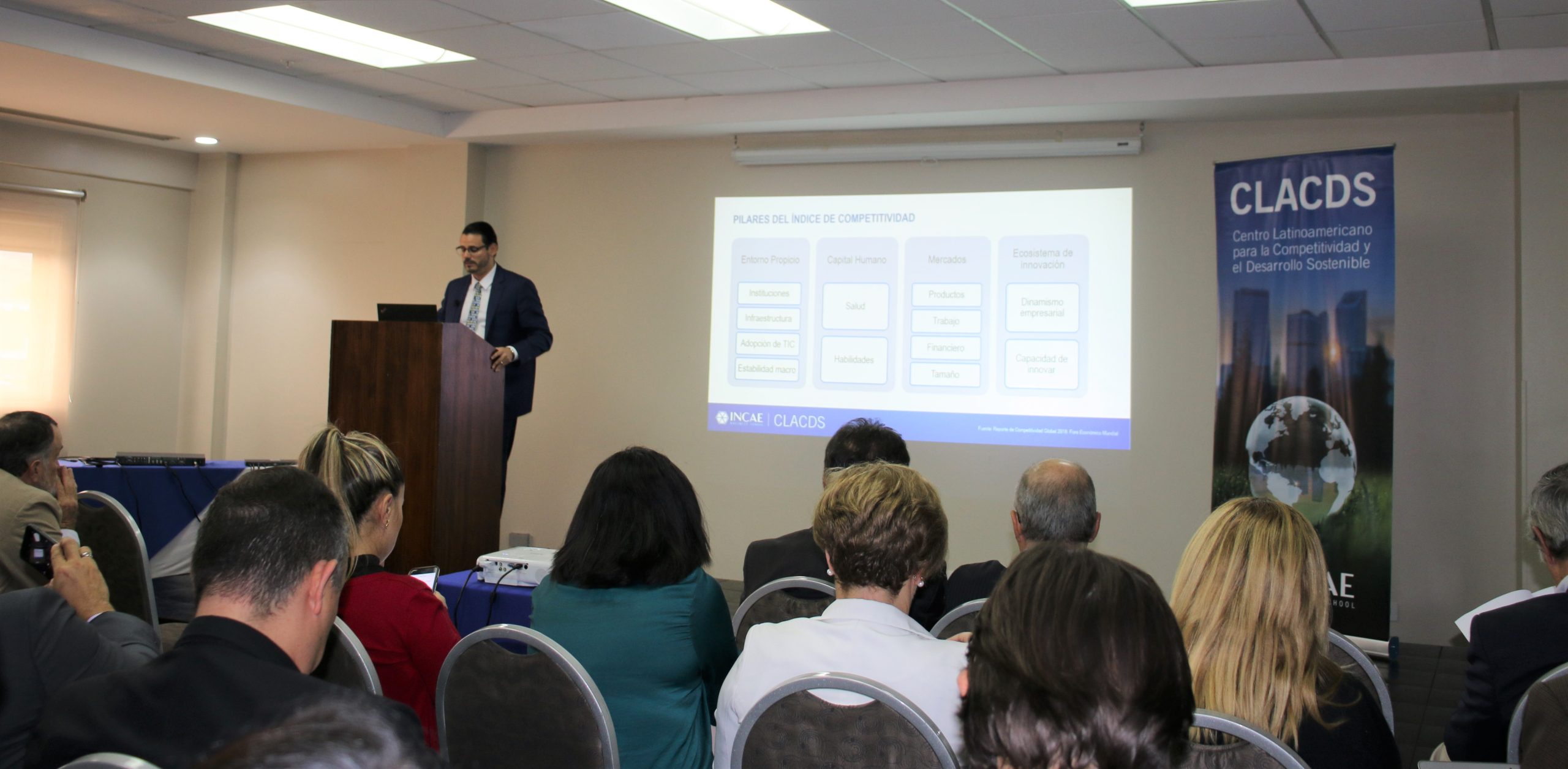
For Ronald Arce, CLACDS researcher, the main challenge facing the country is the slowness with which we are facing the challenges of the 21st century. In the last three years the score in the competitiveness index has barely changed, however, we have lost positions because other countries are moving fast and we in Costa Rica have not been able to adapt to the pace of change.
The fourth industrial revolution will create new relationships between humans and technology that impact the way we work, live and interact. This revolution has the potential for countries to leapfrog stages of development, but it also makes the path less familiar. The ability to take advantage of the opportunities of the fourth industrial revolution requires the "old" conditions of development: institutionality, infrastructure and skills.
This study, carried out with the support of the Latin American Center for Competitiveness and Sustainable Development of INCAE Business School, a regional partner of the World Economic Forum since 1996, analyzes the set of institutions, policies and factors that determine the level of productivity of an economy.
The 2019 report's ratings were constructed based on national and international agency statistics and the World Economic Forum's Executive Opinion Survey of more than 14,000 business people worldwide.
The Latin American Center for Competitiveness and Sustainable Development (CLACDS) of INCAE Business School has contributed to the preparation of this document since 1996 as a regional partner of the World Economic Forum. CLACDS is responsible for collecting information in seven Latin American countries: Honduras, El Salvador, Nicaragua, Costa Rica, Panama, Bolivia and the Dominican Republic.
More information
Press contact: Mauren Esquivel, phone (506) 2437-2394, e-mail mauren.esquivel@incae.edu