- Normally when talking about digital transformation, people think of the private sector. However, it is essential to consider how this process in the public sector can be a catalystfor competitiveness, social progress and economic development in countries.
Digital transformation is a change strategy that involves integrating digital technology in all areas of an organization, altering its operation and the value provided to customers. This process, while prioritizing digital, goes beyond simple digitization, requiring a cultural shift, changing business models and operations. By improving efficiency and fostering innovation, it can drive business growth and provide competitive advantages in an increasingly technological and digital world.
And in the public sector?
Applying digital transformation to the public sector is crucial as it can substantially improve the efficiency, transparency and accessibility of government services. By using digital technologies, governments can optimize their operations, reduce costs and provide a better user experience to citizens.
It also enables the public sector to make data-driven decisions, improving outcomes across a wide range of policy areas. At a time of rising citizen expectations and fiscal constraints, digital transformation can be key to doing more with less.
How is the region doing?
To assess the situation in the region, we will examine one of the 60 indicators of the Social Progress Index, the United Nations Digital Participation Index. This indicator quantifies the Grade to which a government has integrated digital technologies into its public services and the extent to which citizens can access these services online, which are fundamental to social progress in the digital age.
This includes aspects such as the availability of public documents, the provision of public services through digital platforms, and the ability of citizens to interact with officials or participate in decision-making processes online. This indicator is crucial as it provides information on a government's readiness for digital transformation.
Looking at the Digital Participation Index data, it is clear that Central American countries lag significantly behind world leaders and North American countries (Figure 1). In this metric, which ranges from 0 to 1, even Costa Rica and Panama, leaders in the region, are underperforming.
- Middle level: Costa Rica (0.5568), position 66; Panama (0.5114), position 76.
- Low level: El Salvador (0.3523), position 107; Guatemala (0.3295), position 114; Nicaragua (0.25), position 135.
- Very low level: Honduras (0.1023), position 180 out of 193 countries.
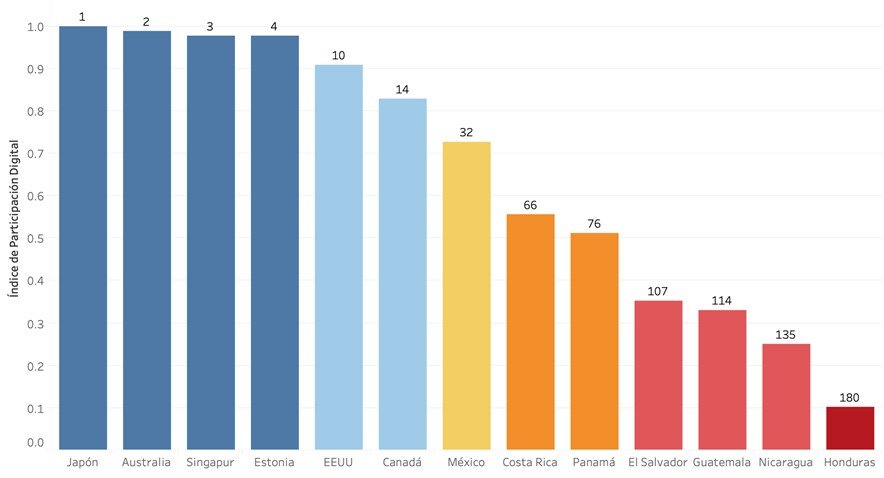
Figure 1: Performance and global position for selected countries in the Digital Participation Index. Source: UN Department of Economic and Social Affairs E-Government Survey.
How to move forward?
To advance the digitization of the public sector in Central America, it is crucial to adopt innovative strategies that prioritize the delivery of services through digital channels. This may involve the development of accessible and easy-to-use integrated platforms, such as user-friendly websites and mobile applications that allow citizens to interact with the government, from paying taxes to scheduling appointments at public hospitals.
The implementation of emerging technologies such as artificial intelligence and cloud computing can significantly improve the efficiency of digital services. For example, 24/7 chatbots that provide quick responses to citizen queries; while cloud computing can facilitate the storage and processing of large volumes of data, such as that needed in urban planning and social service management.
However, these approaches require a solid digital infrastructure, investment in technology and training of public personnel. Therefore, it is essential to train civil servants in digital skills to manage these new tools and platforms.
In addition, it is crucial to address the digital divide to ensure that all citizens can benefit from digitization, regardless of their socioeconomic status. For example, digital literacy training programs could be implemented in rural and low-income communities.
Finally, public-private partnerships are an effective strategy to optimize resources in this digital transformation process. An example of this could be the collaboration with technology companies to implement digital solutions and train public sector workers, from central to local governments.
The risk of not acting
Given this reality, it is clear that if the pace of digital transformation in the public sector is not accelerated, our countries run the risk of being left behind in the global digital economy.
For as more aspects of life become digitized, countries with low e-participation rates will find that their citizens will not be able to take full advantage of the global economic and social opportunities driven by technology.
This may hinder economic growth and social progress, as digital technologies have become an important driver of innovation, productivity and job creation. Aspects in which the region has persistently lagged behind.