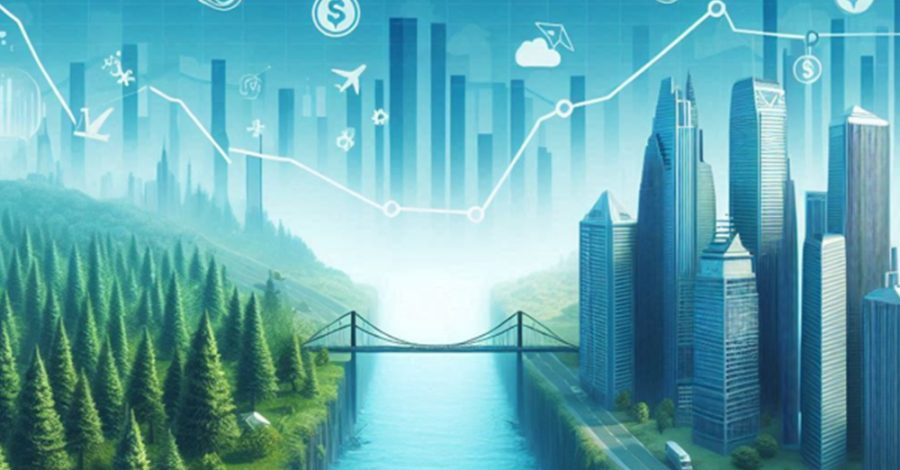
Gross Domestic Product (GDP) is the most traditional measure of a country's economic activity. It represents the total value of all goods and services produced during a given period of time.
Gross Domestic Product (GDP) is the most traditional measure of a country's economic activity. It represents the total value of all goods and services produced during a given period, usually one year. GDP is used as an indicator of a country's economic health and to estimate the size of its economy. When we talk about economic growth, we generally refer to an increase in GDP, which is often interpreted as a sign that a nation is prospering and moving forward.
However, economist Simon Kuznets, who developed the concept of GDP, warned about its limitations. He warned us to distinguish between quantity and quality of economic growth. Thus, Kuznets urged us to consider the costs and returns of growth, and to evaluate economic objectives in terms of long-term benefits. Thus, while economic growth is important for development, Kuznets reminds us that we must ask "more growth of what and for what", to ensure that economic progress also translates into tangible improvements in people's quality of life; in social progress we would say at INCAE.
With this need to differentiate on a high quality type of economic growth to impact the well-being of countries, the World Economic Forum earlier this year introduced a multidimensional approach called "The Future of Growth". This approach is not limited to measuring the quantitative expansion of the economy, but examines the quality, balance and alignment of growth with broader global and national priorities.
The framework assesses the character of a country's growth by analyzing its performance in four key areas to drive more balanced growth: innovation, inclusiveness, environmental sustainability and systemic resilience. These dimensions range from an economy's ability to adapt and evolve in the face of new technological and social developments, to the inclusion of all stakeholders in the benefits and opportunities generated, to the sustainability of keeping the ecological footprint within finite environmental limits and the resilience to withstand and recover from external shocks. This advanced analysis seeks to promote growth that is not only sustainable and resilient, but also inclusive and innovative.
In the region (see Figure 1), the results show diversity according to the World Economic Forum metrics. Costa Rica stands out as a leader in the region, outperforming the global average in Inclusion (62.8) and Resilience (56.6), reflecting its ability to adapt to change and its inclusive approach to the distribution of economic benefits. Although its performance in Sustainability (48.8) is strong and above the global average, there is room for improvement, especially when compared to countries outside the region such as Chile (49.5) and the United States (43.6), which have higher scores in this category. Innovation (43) is its weakest pillar, with a score below the world average.
On the other hand, El Salvador (31.6 in Innovation and 44.4 in Resilience), Honduras (28.6 in Innovation and 42.3 in Resilience) and Guatemala (32.2 in Innovation and 43.8 in Resilience) show significant challenges in terms of their capacity to absorb and adapt to new trends and developments, as well as to recover from external shocks. All of them score below the world average. While Panama presents a more balanced picture with relatively high scores in Inclusion (55.3); and Resilience (55.3), in this pillar it even exceeds the world average, suggesting a greater capacity to manage adversity and recover from crises compared to its Central American neighbors. However, given its income level, it has a low performance in Innovation (46.2) and Sustainability (49.5), lagging behind countries with similar income, such as Chile.
Figure 1.- Scores of selected countries in the dimensions of "The Future of Growth". Source: Own calculations with data from the World Economic Forum.
The recommendations for the region, in view of the results and the context described by the World Economic Forum, should be oriented towards innovation, with an emphasis on education and technical training, encouraging collaboration between universities, companies and governments, and providing incentives for startups and technology companies with better access to financing. In terms of inclusion, it is essential to develop policies that ensure gender equality and the integration of marginalized groups into the economy, expand social protection programs to combat poverty and inequality, and improve infrastructure in rural communities.
For sustainability, the region needs policies that support sustainable practices, encourage the transition to clean energy, and promote environmental conservation, understanding that environmental problems are also economic problems, as has been seen with the drought in the Panama Canal. Finally, to increase resilience, we must invest in disaster-resistant infrastructure, establish early warning and response systems, and diversify economies to reduce vulnerability to external shocks. With a focus on transparent governance and citizen participation, these steps can guide the region toward more robust and just development.
Which, in terms of recent data, means moving away from the lost decades and having high rates of economic growth, sustained over long periods of time that are driven by the added value of our economies, generating formal employment and impacting the quality of life of citizens. Nothing different from what the original Asian tigers did at the end of the 20th century. But of course, for the region to achieve this, it is necessary to break inertia that has been dragging on since the last century; and that is why the World Economic Forum's effort is valuable, because it presents us with new elements to evaluate countries and their governments, based on a global reality that is increasingly distant from the world we knew decades ago, but that we are having trouble letting go of.