- With an alarming 24.45% of the young population in Central America identified as NEET, or young people who neither study nor work, the region is compromising its future. This figure is higher than the world average of 22.23% and the average for OECD countries, which have 11.12% of young people in this condition.
Jaime García, Project Director of the CLACDS Social Progress Index/INCAE.
In a world advancing at the speed of the fourth industrial revolution, where digital technology promises a disruptive social and economic future, the region faces an urgent challenge that if not addressed urgently may limit its ability to generate prosperity. This challenge is the growing percentage of young people who are not in employment, education or training, known as the NEET group.
To fully understand the seriousness of this problem, let us turn to the numbers published by the International Labor Organization. In the Northern Triangle, in Guatemala the percentage of young people who neither study nor work increased from 24.67 % in 2011 to an alarming 31.66 % in 2022. The same is true for Honduras, which has maintained a steady increase in its rates, jumping from 26.53% in 2011 to 31.96% in 2022. Only El Salvador saw its NEET percentage drop from 28.93 % in 2011 to 26.74 % in 2022; and although it shows a decreasing trend in the last year, it still maintains levels above the Latin American average.
In the rest of the region, the phenomenon has remained stable and below the Latin American average. Costa Rica, although with a period of fluctuation, is at 20.16% in 2022. Panama has had a slight reduction in the percentage of young people who neither study nor work, from 20.08% in 2011 to 18.74% in 2022. Although both countries show an increasing trend as a result of the pandemic crisis. In the case of Nicaragua, there is insufficient data to analyze.
The magnitude of this data becomes clearer when we compare with more prosperous economies. For example, North America recorded a percentage of 17.93% in 2022, while the OECD average stood at 11.12%. This comparison serves to emphasize the critical need for action in the region.
Particularly when considering the negative effects associated with a young population that neither produces nor educates itself.
A substantial group of young people neither studying nor working implies untapped potential that could otherwise be contributing to innovation and productivity. A high NEET rate generates significant economic losses in terms of contributions to Gross Domestic Product (GDP) and higher social assistance expenditures by a poorer population.
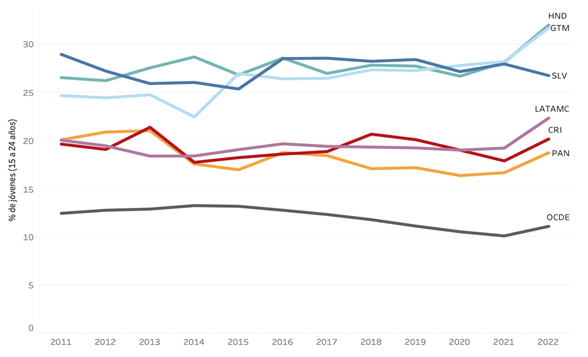
Figure 1. Young people who neither study nor work as a percentage of all young people (15 to 24 years old). Source: International Labor Organization, ILOSTAT.
In terms of well-being, people in the NEET category often face mental and physical health problems due to unemployment and lack of educational engagement. Also, socially, social unrest is magnified, as high levels of generalized frustration and disillusionment foster feelings of marginalization, increasing the risk of social instability.
But despite the bleak scenario, the good news is that it is not an insurmountable challenge. That said, comprehensive policies encompassing education, employment, social protection and, above all, inclusion are required. Addressing the various challenges and barriers faced by women, indigenous communities and other marginalized groups that often form a large part of the NEET population.
And like any complex problem, multi-sector partnerships are required, where the private sector and the education sector can prioritize the development and implementation of vocational training programs, strong career guidance services, and flexible educational opportunities that are aligned with labor market needs; and that facilitate the transition from education to employment.
The future is now and the challenge is not minor, because in a world that is moving towards a tomorrow of Artificial Intelligence and exponential technologies, the right human capital will be the key to attracting investment, increasing consumption, improving productivity; in short, generating sustained economic growth. In this sense, it must be clear that we cannot aspire to a prosperous, modern region with high levels of social progress if young people are not prepared for that future.