The United States approaches the 2024 presidential election amid deep polarization, with polls showing an extraordinarily close race. However, beyond the political divide, data on household income and the Social Progress Index (SPI) for all 50 states reveal a nation marked by inequality. reveal a nation marked by significant structural inequalities.
Thus there are states like Massachusetts that enjoy household incomes of $107,000 and a GPI of 62.08, but others like Mississippi that have $55,000 and a GPI of 47.97. This gap of more than $52,000 in income and 14.11 points in social progress not only reflects different economic realities, but also different life experiences, opportunities and expectations for the future.
In a country as diverse and vast as the United States, these gaps not only reflect local economic realities, but also affect the quality of life and opportunities for millions of citizens. To better understand this picture, it is critical to analyze how incomes and social progress vary across states and what this means in terms of building a common national vision.
This stands out when contrasting high-performing states like Connecticut ($92,000 income and GPI of 61.09) live in an environment where innovation and personal development are viable; while in low-performing states like Arkansas ($63,000, GPI 48.45), traditional jobs are disappearing and educational and advancement opportunities are limited.
The data is also a reflection of the underlying economic structures that influence even the different conceptions of the "American dream. Thus, for states like California ($90,000 income and GPI 55.91), the future is envisioned in terms of technological innovation and a vibrant service economy. However, in states like Louisiana ($58,000 income and GPI 51.82), livelihoods depend more on preserving traditional industries and deep-rooted cultural values. These contrasts lead to different life expectations and perspectives on what it means to succeed in the United States.
Social Progress Index and Median Family Income.
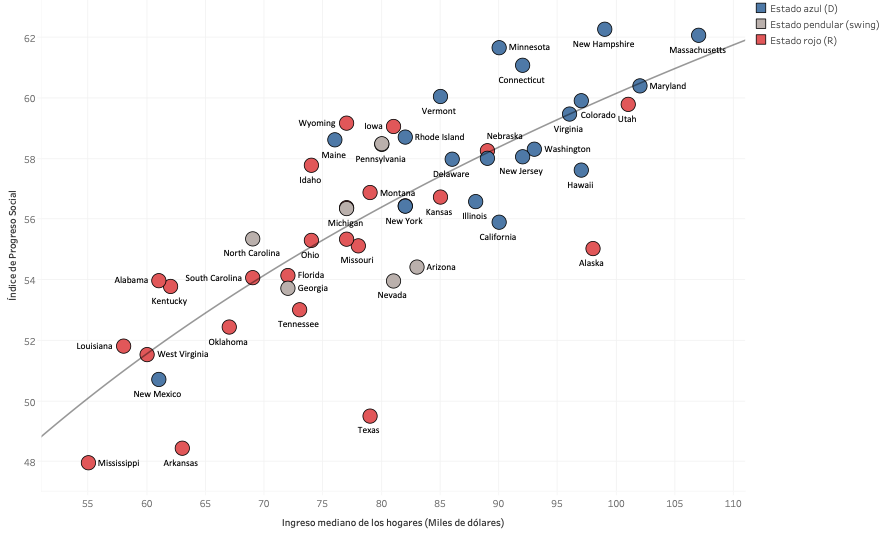
Source: Social Progress Imperative, VisualCapitalist, Federal Reserve Bank of St. Louis.
The differences between "high-income, high social progress America" and "low-income, low social progress America" underscore an urgent need for comprehensive policies that reduce disparities and promote equitable development across the country. However, building a unified national vision requires more than isolated measures; it demands a concerted effort to align the interests and priorities of all states, recognizing their particular realities and aspirations.
Achieving this requires a multidimensional approach that combines policies adapted to local conditions with strategic investment in key sectors. It is not only a matter of implementing knowledge transfer programs or attracting strategic investments, but also of fostering the transition to sustainable economic models. These interventions should respect local cultures and, at the same time, promote economic diversification, especially in high value-added and high-tech sectors. In this way, an inclusive and sustainable development path can be charted, allowing states with traditional economies to modernize without losing their cultural identity.
Finally, to build a common vision of nationhood, success must be measured by the ability to reduce social gaps between states, not just by economic growth, unemployment, or inflation for the country as a whole. This implies that social progress and economic prosperity be accessible to all, regardless of which state one resides in. Redefining the concept of success and social cohesion means bringing it closer to a life experience where the opportunities necessary to thrive exist, a renewed "American dream" for the 21st century; that is the real challenge for the United States, regardless of election results. As the major trading partner of many Latin American countries and home to millions of their citizens, the success of this mission will directly impact the region. For Latin America's sake, we hope they succeed.