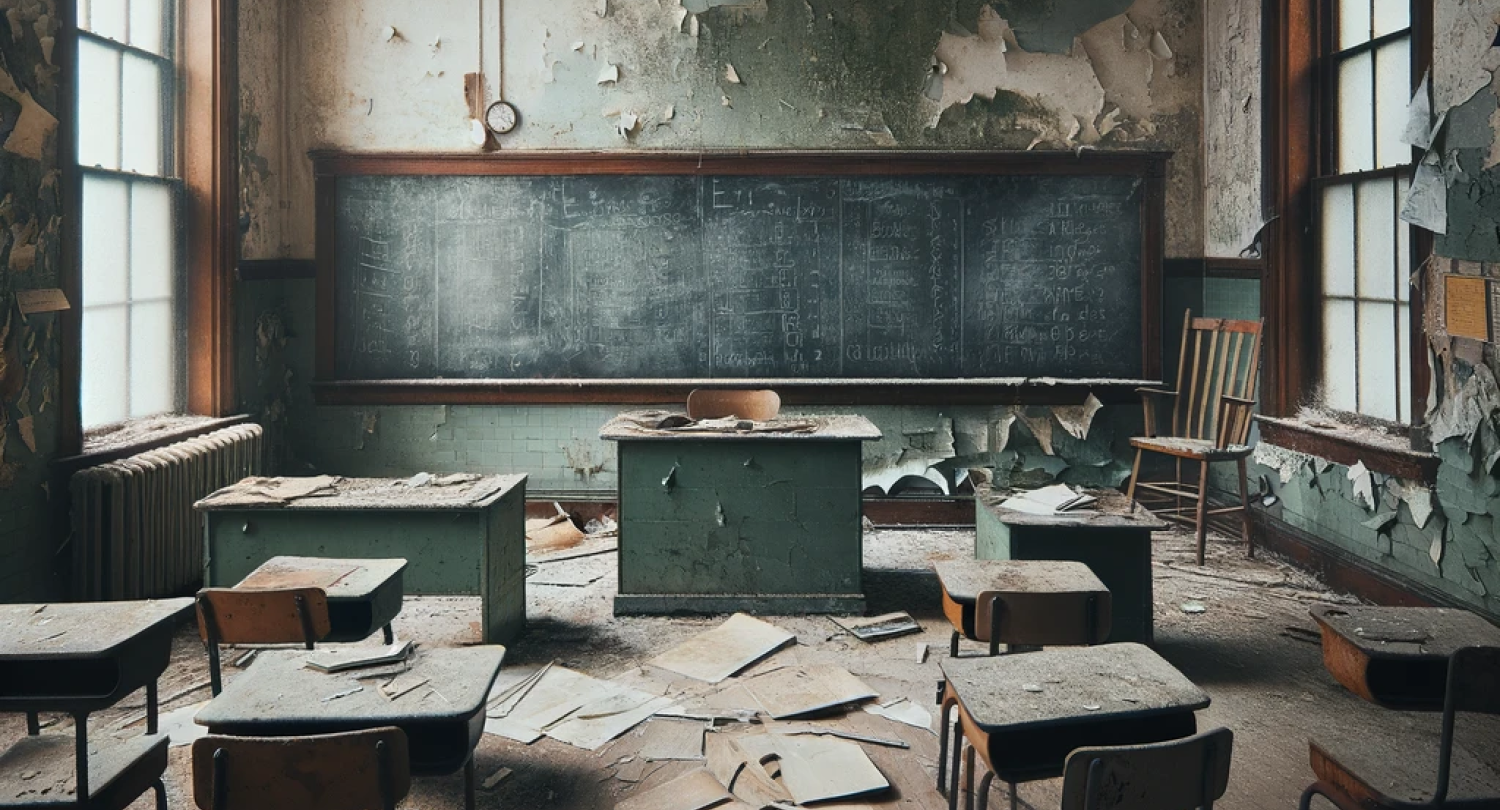
Our 15-year-old students are among the last of 81 countries evaluated in mathematics, reading and science according to the PISA tests. This result is not surprising; neither governments nor society have done their homework to improve opportunities for the region's youth.
The importance of measuring and comparing
The PISA (Programme for International Student Assessment) education tests are a series of international assessments conducted by the Organisation for Economic Co-operation and Development (OECD). These tests are conducted every three years and are designed to measure the proficiency of 15-year-old students in three key areas: reading, mathematics and science.
The main objective of PISA is to assess the extent to which students near the end of their compulsory education have acquired some of the knowledge and skills essential for full participation in society. A country's PISA test results can tell a lot about the quality of its education and its ability to prepare students for the challenges of the 21st century.
High PISA scores are usually associated with efficient and effective education systems, while low scores may indicate problems in education or areas that require attention and improvement. In this measurement, data show that compared to 2018, the average performance of OECD countries had a decrease of 10 points in reading and 15 in mathematics.
This poor performance has to do with a series of structural factors in the educational systems, but also because of the prolonged school closures due to the COVID-19 health emergency, according to the agency.
A region in the lower half of the table
In the region, Costa Rica, El Salvador, Guatemala and Panama were evaluated; the results are worrisome. In mathematics, Costa Rica ranked 63rd, Panama 74th, Guatemala 77th and El Salvador 78th out of 81 countries.
In reading, no country is in the last 5 places; even so, Costa Rica, the best positioned in the region, is in 50th place, Panama in 59th place, Guatemala in 66th place and El Salvador in 70th place. In science, Costa Rica is in 55th place, Panama in 65th place, El Salvador in 72nd place and Guatemala in 73rd place.
The lag with respect to the leading country in the 3 areas evaluated, Singapore, is 10 years. Compared to the OECD, Costa Rica is 4 years behind, while Panama, Guatemala and El Salvador are 6 years behind the OECD.
To address this backwardness, it is not only necessary to invest resources, since the OECD countries invest an average of 102 thousand dollars per student, 3 times more than the Latin American average.
Although of course money is not everything, Panama spends US$60,000 per student and has the same results in Mathematics as El Salvador, which invests barely US$15,000 per student. In contrast, Vietnam has a similar performance to Norway but with an investment amount almost 10 times lower.
It's not "just" knowing how to read and add.
But it's not just about passing the tests; there are a whole host of impacts beyond what is asked. At 15, students are at a critical stage of cognitive and emotional development. Quality education at this age can ensure they acquire fundamental skills such as critical thinking, problem solving and digital competence, essential for the modern world.
If we want a competitive region, we need young people capable of understanding the challenges and opportunities of today's world. Thus, the education of young people has a direct effect on economic development.
A well-educated workforce is better able to adapt to changing economies and contribute significantly to the region's economic growth. In this sense, education is a powerful tool for reducing poverty and inequality. It provides young people with the skills and knowledge they need to improve their living conditions and access better opportunities.
But education also generates other non-monetary benefits, such as fostering stable and healthy social environments, where effective education at this age can play a crucial role in crime prevention, offering young people alternatives and positive life trajectories. This in Central America, where young people face challenges such as violence and crime, is a very positive impact on social progress in the region.
We haven't done the homework, and it was due yesterday.
Much will be analyzed and written about these results; but in a nutshell, we know the task but we do not do it. Improving these mediocre results requires a comprehensive approach that addresses various educational aspects that can be evaluated and monitored.
This includes investing in teacher training and professional development. In addition, it is crucial to update curricula to focus more on the development of critical and problem-solving skills, as well as digital literacy.
Work must also be done to reduce educational inequalities, a product of income inequality. This of course requires collaboration between the government, the private sector and families not only to facilitate the necessary investment and the implementation of effective educational reforms, but also to really prioritize education with the urgency of a regional emergency that today is destroying our present and future prosperity.