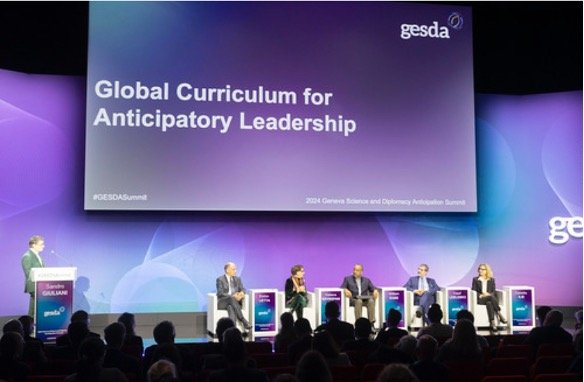
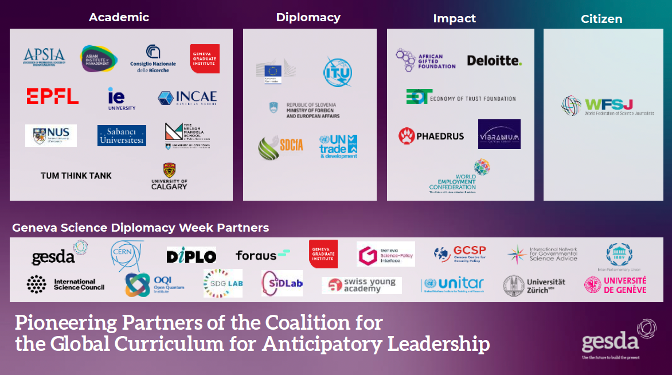
Geneva, October 11, 2024. On the third day of the Geneva Science and Diplomacy Anticipation Summit in Geneva, the Global Curriculum for Anticipatory Leadership (GCAL) initiative led by Geneva Science and Diplomacy Anticipator (GESDA) was officially launched, marking a significant step towards preparing leaders around the world for accelerated transformations driven by science and technology. The launch, led by Ignazio Cassis, the Swiss Minister of Foreign Affairs, and Enrico Letta, President of GESDA's Diplomacy Forum, brought together heads of international organizations, universities, policy makers, diplomats, business leaders and citizens to highlight the need for evidence-informed, future-oriented leadership.
GCAL is a program designed to train leaders with the knowledge, skills, mindset and tools necessary to navigate the increasingly complex dynamics of the modern world. To this end, a benchmark curriculum has been developed that combines fundamental knowledge of science, international relations, business and economics and world affairs, scientific anticipation, science diplomacy lenses, and leadership skills to enable effective and collaborative responses to global challenges.
A major effort in 2025 will be five Anticipatory Leadership Weeks in five different regions of the world ("25/5/5"), intensive and immersive training programs that combine local expertise with global insights, fostering cross-sector dialogue and cooperation. The following cities and institutions will serve as regional hubs for anticipatory leadership training:
- Istanbul (Turkey) with Sabancı University.
- Madrid (Spain) with IE University
- Pretoria (South Africa) with the Science Diplomacy Capital for Africa
- San José (Costa Rica) with INCAE Business School
- Singapore with the National University of Singapore
Prof. Camelia Ilie, Dean of Strategy and Institutional Affairs at INCAE, who is leading the project on behalf of the institution, participated in the high-level panel presenting the business case of the program from a business school perspective, commenting: "Global challenges are increasingly complex and we require different models of governance, leadership and decision making to solve them. The problems are interrelated, therefore, solutions cannot be given in silos. On the contrary, they must be coordinated between public institutions, the private sector, academia and civil society. They must be inclusive to avoid bias and be multi-stakeholder oriented.
Therefore, leadership development programs must shift their focus to prepare leaders with a curiosity-driven learning mindset and the ability to incorporate scientific advances, technological tools and data analytics into their decision-making processes. Their ability to create collaborative models between humans and artificial intelligence will be key to designing better solutions faster. For this to become a reality, governance models must also be revamped to focus more on foresight and less on merely analyzing the past.
Our goal is to promote leaders who can do all of the above while leading with purpose and shared values toward a more sustainable world where human beings can live not only longer but also more meaningful lives. We hope to meet these objectives with the Global Curriculum for Anticipatory Leadership, working under the leadership of Enrico Letta and GESDA and in collaboration with all partners around the world. For Latin America these types of programs have a very significant importance because we can accelerate social progress by incorporating scientific advances and technology to reduce gaps. "