In a context where government efficiency and transparency are crucial to sustainable development, Central America is emerging as a laboratory for innovation in public management. Through the adaptation of proven business principles, specifically Lean Management, the region is transforming the way local and potentially national governments serve their citizens.
From Industry to Public Administration
The concept of Lean Management, originated in the industrial sector and perfected over decades, has revolutionized the way organizations optimize their processes and resources. Today, these same principles are being successfully adapted to the Central American public sector by INCAE Business School through the development of Lean Public Management (LPM), demonstrating that efficiency is not exclusive to the private sector.
The methodology is based on two transformative concepts:
- The replacement of "Task Thinking" by "Process Thinking".
- Adopting a continuous improvement mentality
This approach represents a paradigm shift in public administration, traditionally dominated by a legalistic approach that sees in the modification of laws and regulations the solution to all efficiency problems.
Tangible Results: The TEAM-NT Case
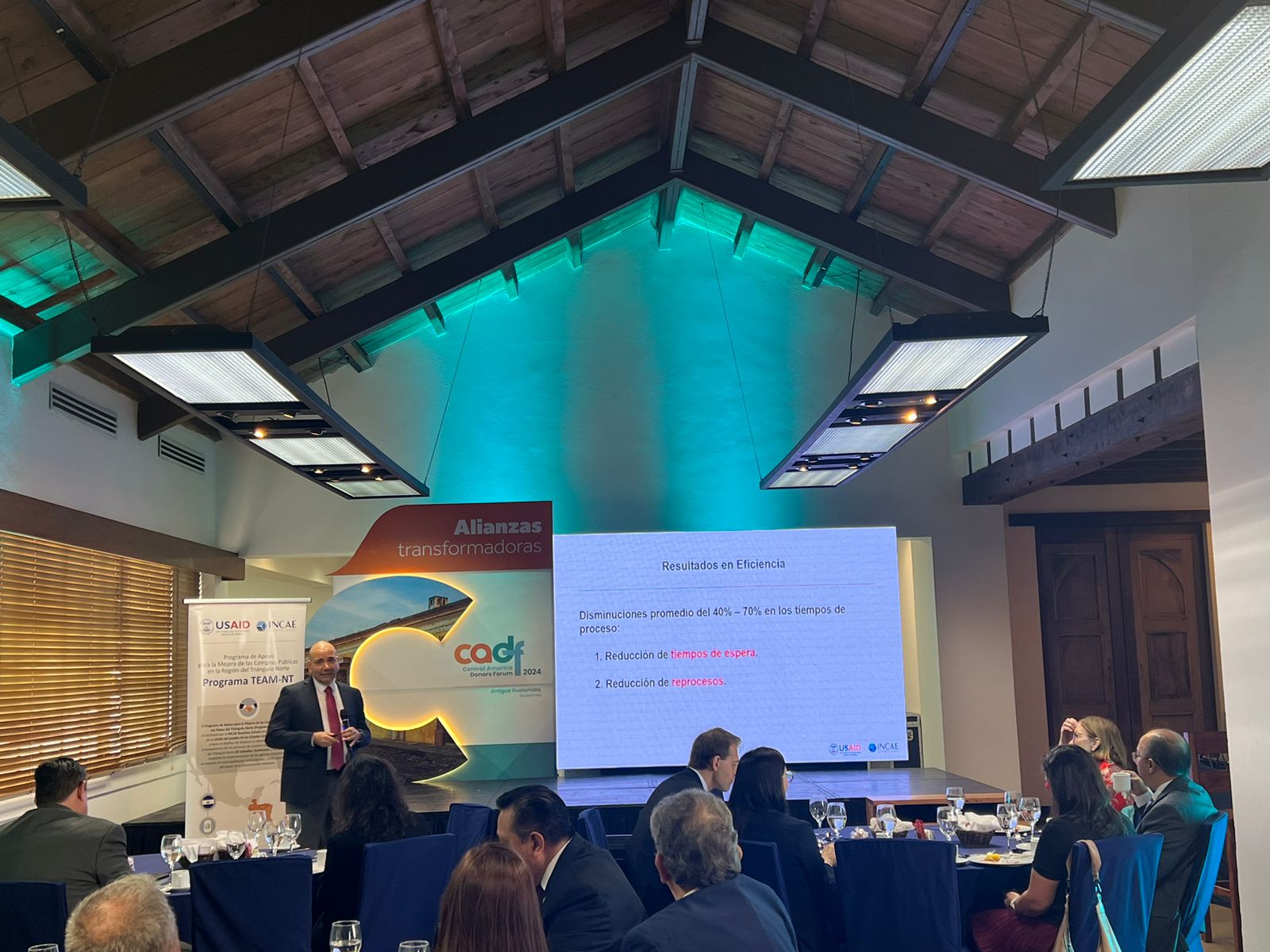
The Support Program for the Improvement of Public Procurement in the Northern Triangle Countries (TEAM-NT), a USAID-sponsored initiative of INCAE , has demonstrated the transformative potential of LPM. Implemented in 24 municipalities in Honduras, El Salvador and Guatemala, the program has impacted a population of approximately 5 million inhabitants.
The results are conclusive:
- In Honduras, the time for minor purchases has been reduced from 142 to 30 days.
- In El Salvador, competitive bidding went from 162 days to 32 days
- In Guatemala, bidding processes were shortened from 210 days to 146 days
These achievements were accomplished without significant legal changes, but rather through the optimization of existing processes, eliminating unnecessary steps and improving efficiency within the current legal framework.
A New Public Management Paradigm
The LPM methodology developed by INCAE introduces three fundamental elements that transform public administration:
- Focus on Results: By thinking in terms of complete processes rather than isolated tasks, staff members concentrate on the final impact of their work.
- Use of Data: Continuous measurement allows objective evaluation of the efficiency and effectiveness of processes.
- Teamwork and Empowerment: Cross-departmental collaboration breaks down bureaucratic silos and fosters innovation.
Beyond Public Procurement
Although TEAM-NT focused on government procurement, the potential of LPM extends to virtually any public administrative process. From business registration to the issuance of construction permits, the methodology provides a framework for identifying bottlenecks, implementing solutions and monitoring results.
TEAM-NT's experience demonstrates that there is great untapped potential in the optimization of Central American public management. At a time when the region is seeking to accelerate its development, LPM offers a cost-effective route to improve the quality of public services and government efficiency.
The commitment demonstrated by the municipalities participating in TEAM-NT suggests that there is fertile ground for the expansion of these practices. The key is to provide the appropriate technical support and methodology to officials who are already motivated to improve their service to citizens.
Looking to the Future
INCAE plans to expand its LPM program to more municipalities and, for the first time, to national government institutions. This expansion represents a unique opportunity for Central America to lead in public management innovation.
At a time when the region is facing significant challenges, LPM emerges as a powerful tool for transforming public administration. By making government processes more efficient and transparent, it not only improves the quality of public services, but also establishes a solid foundation for sustainable development throughout the region.
The silent revolution in public management is finding its expression in the corridors of Central American city halls. And with each streamlined process, with each simplified procedure, the region takes another step towards a future of greater efficiency, transparency and prosperity.