Statistics show that the most democratic countries, that is to say, the countries that respect institutions, those that have the rule of law, those that have the independence of the branches of government, those that have clear rules of the game, those that have a credible judicial system , are the least corrupt countries, the countries with the best level of education and the highest per capita income and, therefore, the countries with the greatest social progress for their citizens.
The Global Competitiveness Report of the World Economic Forum, of which INCAE is a member, indicates that in Latin America the countries that led the region were Chile (ranked 33rd) and Costa Rica (ranked 47th). At the other extreme, El Salvador and Venezuela were two of the three worst countries.
The Corruption Index Report, prepared by Transparency International, reports very similar results. The Latin American countries with the lowest corruption index are Uruguay, Chile and Costa Rica. Those with the highest index are Guatemala, Nicaragua and the worst Venezuela.
In other words, it must be clear to all of us that democracy and the rule of law are fundamental factors for the development of a society and the well-being of its citizens.
Just as it is clear that an MBA INCAE is fundamental to making us more successful professionals, it should be clear that democracy and the rule of law are fundamental to a better society.
So how do we build the region and the country we want to hand over to the next generations? How do we ensure that our countries are viable for our children and grandchildren? Doing more of the same will not get us to where we want to be.
Institutionality in Latin America has deteriorated with failed democracies and corruption scandals throughout the region. The Odebrecht case, which involved government officials in many of our countries to obtain benefits in public contracts, is the textbook definition of corruption and lack of work ethics.
Former presidents of several countries in the region are in jail or at the gates of judicial proceedings; other presidents are facing weeks of tension due to social protests that have already resulted in dozens of deaths, as is the case of Nicaragua, whose government until recently was classified as stable, with alliances with the productive sector, good macroeconomic health and acceptable economic growth.
History reminds us once again that true social progress is achieved where there is institutionality and democracy, where corruption is penalized. Only then will our countries be able to offer the security, respect and ethics that their citizens deserve and then they can be considered viable for investments that generate decent jobs and inject capital into our economies.
But democracy is more feasible in educated societies, because, as Nelson Mandela said, education "is the most powerful weapon for changing the world".
When a country lacks education, it will not even be able to move to the stage of efficiency, much less innovation. This will only widen the gap between the wealthy minority and the vast population at high levels of extreme poverty.
The needs in education are complex and include preparation for a drastically changing world that we struggle to understand. But everyone sitting here can change the reality of our societies, even if it is one person at a time.
So I ask again the question: how do we build the region and more specifically the country we want to hand over to the next generations?
In countries like ours, the private sector has a much greater responsibility than its profitability. Its construction function is as indispensable as that of politicians, without whose presence societies drift into anarchy, autocracy and failed societies.
In all Latin American countries, the private sector has the responsibility to watch over the institutional framework. To ensure that we have good politicians to achieve long-term sustainable and inclusive development by investing in education, in the construction of strong institutions, in search of a path of economic progress and welfare for all citizens. This is doing politics correctly and it is up to all of us to participate.
Only in this way can we begin to break the cycles of our countries, with professionals who promote income through their businesses, but respecting the concept of sustainability through respect for our natural resources, fostering social inclusion, and promoting institutionalism, since, as we well know, there can be no successful companies in failed societies.
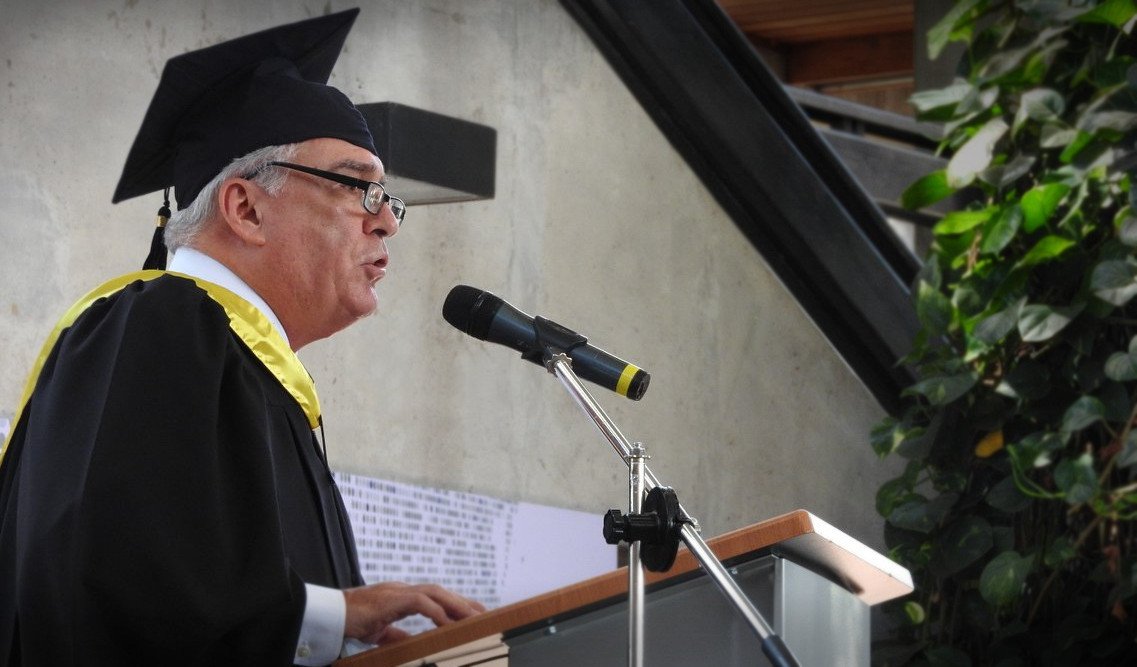
Excerpt from the speech given by Enrique Bolaños, Rector of INCAE, during the Graduation Ceremony of the Executive MBA 2018-I.
Through weekly modules designed under the highest standards, taught by a faculty trained in the most prestigious universities in the world and with classes taught in three continents, INCAE gives you the opportunity to acquire, together with professionals from all over the region, a global management vision with local relevance. Next edition: August, 2018.
Designed to fit the time and investment needs of today's professionals, our executive master's degrees offer cutting-edge education delivered by the best faculty in the region and enhanced by partnerships with several of the world's most prestigious business schools.