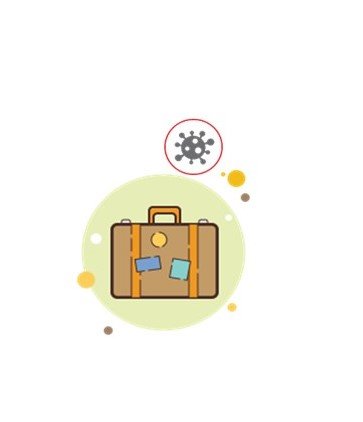
One of the sectors most affected by the COVID-19 pandemic has been tourism. The World Tourism Organization (UNWTO) estimated a 22% drop in the first quarter of the year at the international level; and various scenarios are contemplated according to how quickly borders can be opened and international visitation can be reactivated. The 3 scenarios are a 58% drop in international tourist arrivals if travel restrictions are relaxed in early July; scenario 2 with a 70% drop if travel restrictions are relaxed in September, and scenario 3 with a 78% drop if they occur in December. On the air transport side, a drop in air passenger traffic is estimated at the end of the year of between 44% y 80% according to the International Air Transport Association (IATA).
This negative trend is affecting an industry that in Costa Rica directly contributes 6.3% of GDP; in Mexico 8.7%, Honduras 8%, El Salvador 5.1%, Nicaragua 5%, Guatemala 5.9% and Peru 3.9%. This economic impact is linked to the performance of activities such as lodging, transportation, medical care, recreational and artistic activities, car rental, air transportation, food and beverages, mainly. This means millions of people without jobs, due to an industry that is practically at a standstill.
According to the report "COVID-19: Travel Restrictions, a Review for Global Tourism", published on May 29, also by UNWTO, it is found that 100% of the world's tourist destinations have some type of restriction on tourism. published on May 29, also by the UNWTO, it is found that 100% of tourist destinations worldwide have some kind of restriction for tourism. From the complete or partial closure of borders for tourists, which applies to 85% of destinations; complete or partial suspension of international flights; border closures depending on the country of origin; and only 12 destinations (5%) currently have protocols in place to accept tourists.
These 12 countries are Belarus, Ethiopia, Ireland, United Kingdom, Zambia, Bhutan, Korea, Bangladesh, Kiribati, South Sudan, and Tanzania. Iceland, Greece, y Portugalwhile Spain is planning to open in July for European tourists. Protocols and measures for tourists in these countries range from quarantine periods upon arrival, COVID-19 testing, or arriving with medical certificates validating that they are not carriers of the coronavirus. It is expected that as the countries control contagions and the spread of the virus, the economy will open up, including tourism activities.
However, and as has been consistently mentioned, until there is a COVID-19 vaccine, it is not yet possible to COVID-19 vaccine or a truly effective treatment vaccine or a truly effective treatment, we will have to live with the coronavirus and adapt our behavior to the "new normal". "the "new normal in order to bring the spread of the disease under some control. And of course, this "new normal" will apply to the tourism sector, significantly changing the way we travel, or enjoy a vacation.
Tourism in a world with COVID-19 will change the decisions we make about where to travel, it is expected that tourists will choose places where they are not at risk of contracting the virus, in fact the World Travel & Tourism Council (WTTC) is already working on a "safe travel The World Travel & Tourism Council (WTTC) is already working on a "safe travel" seal so that companies can show tourists that they comply with the appropriate protocols to take care of their health.
Before leaving it will be important to investigate all the protocols in the country to be visited and know the requirements to be met, from the mandatory use of masks, to having to pay for a COVID-19 test upon arrival in the destination country, some countries like Iceland have even launched two-week free testing promotions.
At airports, protocols are being implemented protocols In addition, they are promoting an intensive use of technology to avoid physical interaction between people as much as possible. In this area of technology use, online check-in, contactless immigration procedures and electronic payment mechanisms are recommended. The objective is to guarantee the health and safety of travelers and workers, minimizing negative impacts on efficiency and operations.
In hotels, distancing and hygiene measures will have to be part of the operating model; already there are countries y international organizations are already publishing their protocols and are in the process of training companies in the sector. These protocols include of course more intensive hygiene methods such as the use of ultraviolet light, or new disinfection technologies such as electrostatic sprayers. The taking of temperature when entering enclosed areas. The disappearance of buffets or coffee stations. Creation of positions such as "hygiene and protocol manager". Encouraging new products based on room service or the reservation of outdoor spaces, such as reserving time at the swimming pool. In addition to having rooms ready in case you need to quarantine someone.
In the rest of the tourist activities, the principles of hygiene and social distance will also be the conditions to be followed. By decreasing the tour sizesIn the rest of the tourist activities, the principles of hygiene and social distance will also be followed by reducing the size of tours, eliminating mass tourism, limiting activities in enclosed areas, prohibiting group dynamics, promoting the use of masks in tourist attractions and theme parks, and limiting occupancy in restaurants and bars. Even on the beaches traditional behavior must be changed, since measures are being taken to limit the number of people who can access, to put distance between umbrellas, between families sunbathing, or with the lifeguard; in addition to including signage to show the occupancy levels, and to use masks or face shields.
The success of these measures will depend on applying the protocols with extreme discipline in all links of the tourism value chain; but also on knowing how to communicate them to visitors. Of course, technology will be key to complying with the new measures, both for testing, communicating, paying, booking, and even for continue to monitor the COVID-19. COVID-19. But tourism is clearly different when there is a pandemic; the different measures and protocols seek to generate confidence and ensure that the act of traveling is safe, without putting travelers, workers and residents at risk, respecting health regulations, but activating an industry on which millions of people depend. But only countries and destinations that can truly generate trust and safety will be able to attract tourists.