The Coronavirus has come to deteriorate the standard of living of billions of people in the world; and of course, we must not only think of the infected, which are already counted in millions; or the hundreds of thousands of dead. But also the millions of families who are seeing their income reduced, either by the reduction of their economic activities, or by unemployment and the impossibility of getting a new job opportunity.
The economic outlook is not very encouraging, the World Bank has again estimated the economic impacts of the pandemic; and the results, especially for our region, are not optimistic, as the fall in Gross Domestic Product (GDP) is expected to be -7.2% in Latin America, with a decrease of 8.1% in GDP per capita. Latin America will be the region most affected by the economic impact of the pandemic. Compared to the last recessions, in the great recession of 2009, the region's GDP fell by -1.8%, and in the crisis of the 80s, in 1982 there was a fall of -0.5%, while in 1983, the economy contracted -2.52%. In the words of ECLAC, we are facing the worst economic crisis in the modern history of Latin America, a fall not seen since the period from 1914 to 1930.
This deterioration in economic activity has a direct impact on people's employment conditions, reducing working hours, affecting working conditions, encouraging informal employment, or increasing unemployment. Regarding the latter, ECLAC expects the region's unemployment rate to rise to 11.5%, with 37.7 million people out of work; an increase of 11.6 million over the previous year. Although, of course, the impact is different among economic activities, as some have been more affected by the pandemic than others, for example, tourism is practically at a standstill worldwide, but not food production.
The International Labor Organization (ILO) (ILO) has classified economic activities according to the level of impact they are having as a result of the pandemic. In this regard, the ILO estimates that the activities of lodging, food preparation, manufacturing, wholesale and retail trade and real estate, are having a high impact on their production, considerably increasing unemployment, as they are labor-intensive sectors, employing millions of people with low wages, and in general with a low level of qualification, particularly in lodging, food services and retail trade.
Source: ILO Observatory: COVID-19 and the world of work. Second edition.
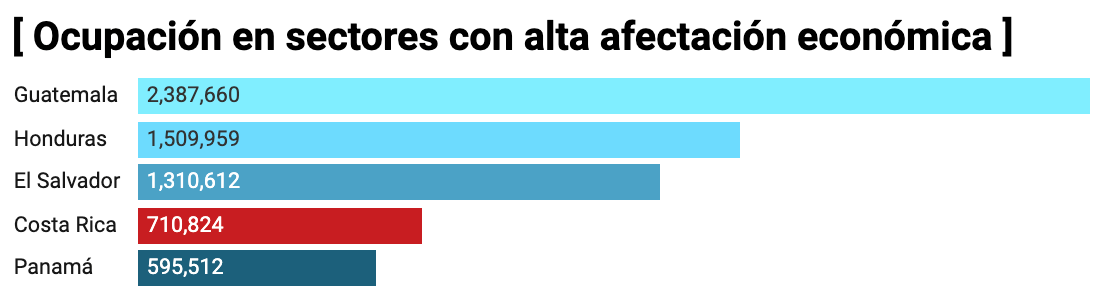
Highly affected economic activities account for 37.4% of global employment, but in Latin America this share rises to 42.4%. And if we consider employees in medium-high risk activities, the percentage is 16.5%; that is, more than half of the labor force in the region is in activities severely affected by the pandemic. There are also differences between countries, since in El Salvador the proportion of people employed in highly affected sectors is 46.6%, in Honduras it is 36.9%, in Guatemala 34.4%, in Costa Rica 32.7% and in Panama 31%. In absolute numbers, for the total of these 5 countries in the region, we are talking about 6,514,567 people at risk of reducing or losing their income.
Source: ILO Observatory: COVID-19 and the world of work. Second edition.
And just as the Coronavirus is testing the health systems of the countries, the economic crisis resulting from the pandemic will test the capacity of the economies to generate jobs. In this sense, if we analyze the performance of Central American countries during the 21st century, the results are very contrasting, because while Guatemala has maintained low unemployment rates close to 3%; Costa Rica has seen a steady deterioration in this indicator, going from an average of 6.06% in the period 2000-2004, to a rate of 9.44% in the last 5 years. And its latest unemployment figure, recently released, shows a rate of 15.7%, the highest in the last 30 years.
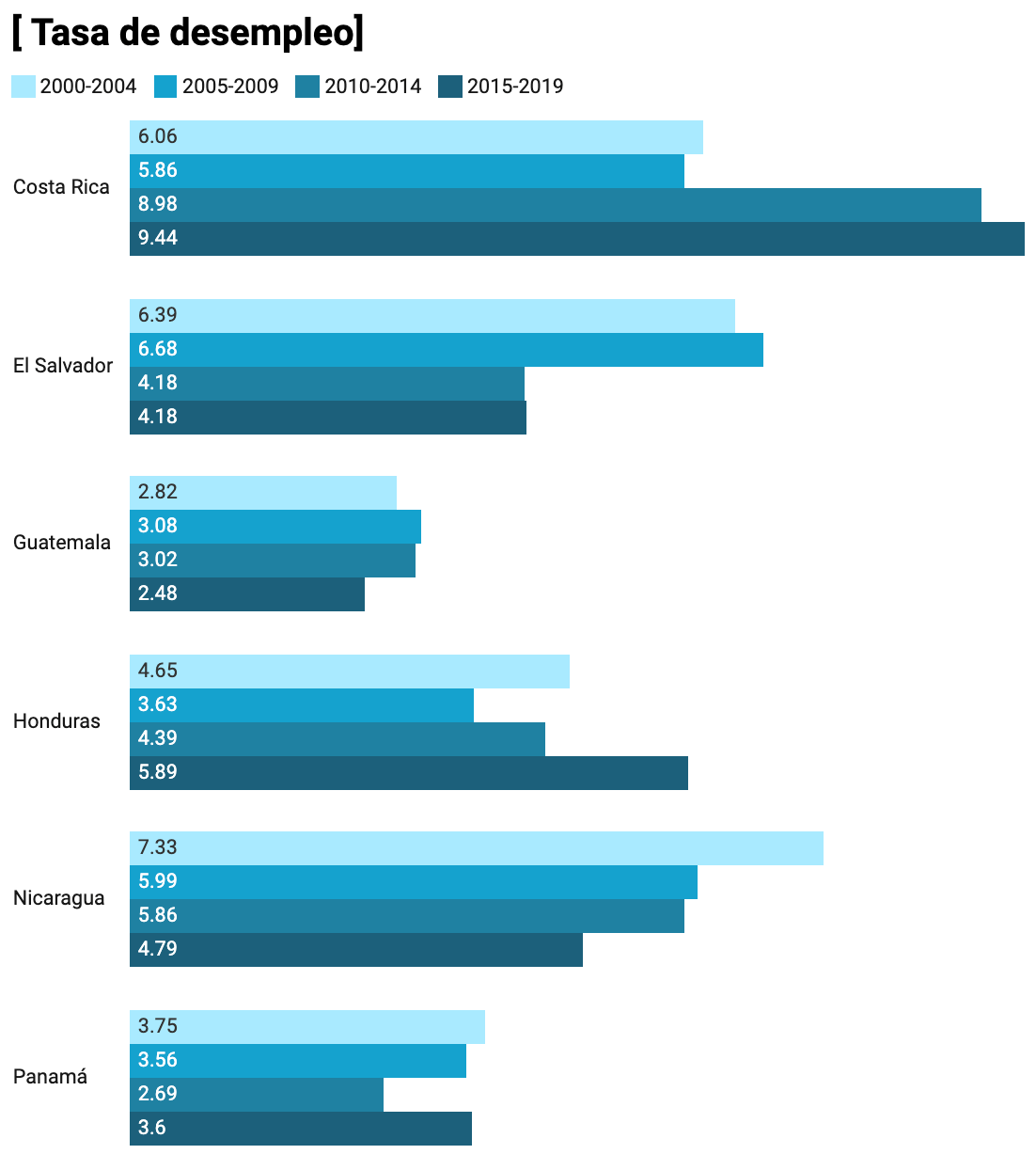
Source: Own calculations with data from the World Bank.
In order for our countries to reduce the economic and social costs of the pandemic crisis, projects and strategies will have to be implemented to build a more solid, transparent and efficient institutional framework. Take advantage of the sudden digitalization forced upon us by the pandemic and reduce business opening times, public service procedures, create one-stop shops to facilitate the construction and interaction between citizens and local governments. Interventions based on public-private partnerships must be promoted, since it is clear that it is the companies that create prosperity and jobs, but it is the government that facilitates the business environment. In addition, rehabilitation must be implemented to promote the competitiveness of countries in the short and medium term, to bring prosperity to rural areas, and to generate employment for women and young people, reducing the digital divide and increasing access to financial markets.
In other words, an agenda of competitiveness and social progress needs to be put into action for a rapid and inclusive recovery. If these types of changes and strategies are not implemented, the modest progress that the region has made in recent years risks not only halting, but reversing. The World Bank has already warned of an increase in global poverty as a result of the pandemic, affecting the global trend of extreme poverty reduction. And today, in the midst of the "new normal", still trying to learn to live with the virus, we must begin to flatten the unemployment curve and resume the path to economic growth, this time focused on building a more resilient economy and society. But only the most disciplined countries and societies that manage to comprehensively address health, social and economic needs, from a macro level but also from the behavior of each individual, will be able to minimize the impacts of the current crisis.