Tourism is much more than a source of entertainment for travelers. In Latin America, a region with a wealth of natural and cultural capital has the potential to be a powerful engine for the social, inclusive and sustainable development of host communities. Here, tourism can generate prosperity in a sustainable way, taking advantage of the diversity of resources and overcoming the particular challenges of the region.
The
World Economic Forum's Travel & Tourism Development Index (TTDI) provides a comprehensive framework for assessing and improving the factors that enable sustainable and resilient development of the tourism sector. It is organized into five main dimensions: Enabling Environment, T&T Policy and Enabling Conditions, Infrastructure and Services, T&T Resources, and T&T Sustainability. This holistic approach reminds us that tourism should not only be an enriching experience for the tourist, but also for local communities.
Authentic tourism experiences that allow travelers to interact with local culture and participate in sustainable activities can strengthen local economies and promote respect for and conservation of natural and cultural resources. However, achieving this type of sustainable and inclusive tourism is not an easy task in Latin America, where there are challenges such as improving security, human capital, tourism infrastructure and protecting natural areas and endangered species.
But along with these challenges, Latin America also has great opportunities. Its high biodiversity and the presence of unique eco-regions can attract a significant number of ecotourists. In addition, tourism in the region tends to generate a considerable number of well-paying jobs and reduce the gender gap in employment. And in many countries, tourism is a government priority, which facilitates the development of favorable policies and investment in the sector.
The TTDI 2024 results for Latin America reflect this mix of challenges and opportunities (see Table 1). Some countries, compared to the 119 evaluated, stand out for their natural resources and the socioeconomic impact of tourism, while others need to improve in key areas such as security and infrastructure.
In the region, Costa Rica (51st) has improved its position by 4 positions thanks to its biodiversity and sustainability policies; El Salvador has also improved 4 positions due to its improved competitiveness. Nicaragua (108th) and Honduras (111th) have dropped 2 and 3 positions respectively, sharing challenges in the development of its tourism sector. Guatemala (100th) and Panama (63rd), with falls of 5 and 6 positions respectively, show gaps in human capital, tourism infrastructure and positioning of their cultural and natural tourism resources.
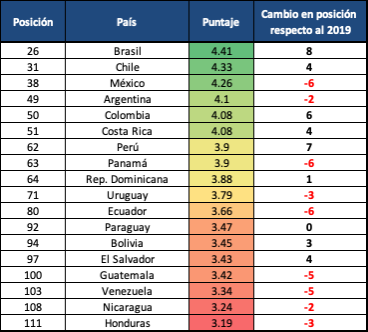
Table 1. Latin America's performance in the Travel & Tourism Development Index 2024. Source: World Economic Forum data.
In short, tourism in Latin America has the potential to benefit both visitors and host communities. Thus, the results of the index provide a roadmap for improving policies and practices, fostering sustainable and resilient growth. So, with the right approach, tourism can truly drive both economic prosperity and social, inclusive and sustainable progress in the region.