The World Economic Forum's recent Travel & Tourism Development Index 2024 reveals that Latin American economies have experienced mixed progress in the development of their travel and tourism sectors since the pandemic.
The index methodology combines quantitative statistical data from reputable international sources and the executive opinion survey of business leaders in the different countries. A total of 119 economies were evaluated using 102 key indicators grouped into five categories (enabling environment, travel and tourism policy, infrastructure and service, tourism resources and sustainability) that measure how attractive and prepared a country is to tap into tourism potential and positively impact society.
Globally, the United States led the ranking, followed by Spain, Japan, France and Australia as the five most competitive economies in travel and tourism. On average, the Americas region underperformed the global average.
In Latin America, Brazil (26) and Chile (31) obtained the highest scores, followed by Mexico (38), Argentina (49), Colombia (50) and Costa Rica (51). Peru (62), Panama (63) and the Dominican Republic (64) occupied lower positions (see Table 1).
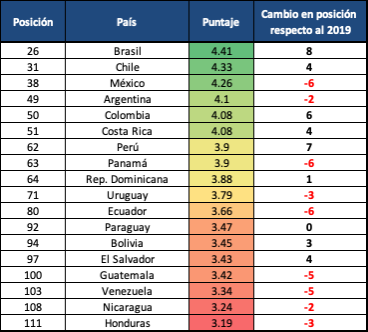
Table 1. Latin America's performance in the Travel & Tourism Development Index 2024. Source: World Economic Forum data.
While some nations have made progress in areas such as the environmental sustainability of tourism, the region as a whole continues to face significant obstacles that limit competitiveness in this lucrative sector.
"Despite Latin America's great potential for nature-driven tourism and the positive socioeconomic impact of this industry, the region still faces several key challenges," the report said.
Among the main challenges identified are:
- Poor business and security conditions, including high levels of organized crime and violence in several countries.
- Need for greater conservation efforts to protect key biodiversity areas and endangered species.
- Lag behind in broad tourism growth enablers, such as infrastructure, human capital, and technological adoption.
The report urges governments and key stakeholders to proactively shape the tourism sector to make it more resilient, inclusive and sustainable for the future.
"Tourism can be an engine for progress in areas such as environmental sustainability, economic prosperity and global connectivity in our region," said Ronald Arce, executive director of CLACDS at INCAE Business School. "But it will require coordinated public and private sector efforts to overcome current obstacles."
The Latin American Center for Competitiveness and Sustainable Development (CLACDS) of INCAE Business School, as a partner of the World Economic Forum (WEF), collaborated in the collection of data for the report in seven countries in the Latin American region.
For more information write to: Isabel Solis, isabel.solis@incae.edu
Image by jcomp on Freepik