- Faced with a 2023 that breaks global temperature records, extreme weather materializes as a risk factor for the regional economy.
According to the European Union's Copernicus Climate Change Service, July will be the hottest month on record, with the hottest three weeks and the three warmest days since 1940, and the highest ocean temperatures ever recorded for this time of year. In that sense, trends seem to indicate that 2023 will be one of the hottest years on record. These extreme temperatures affecting the entire world are a consequence of several factors, mainly climate change caused by human activities, and the recently confirmed El Niño phenomenon.
El Niño is a climatic event that occurs every 3 to 4 years, when the waters of the equatorial Pacific Ocean warm more than normal. This warming causes changes in global weather patterns; and can last from a few months to a year or more. Currently there is a 90% chance that it will continue through the northern hemisphere winter. The effects of El Niño can be very varied, including heavy rains, floods, droughts, forest fires, and changes in marine and terrestrial ecosystems.
It is important to understand that extreme weather events go beyond being aspects of the environment, they are also economic factors; for example, they can have a devastating impact on agricultural productivity. Prolonged droughts, floods, heat waves and extreme storms can destroy crops, alter growth patterns, spread pests and diseases, and ultimately reduce yields, limiting the amount of produce available for sale and export. In that sense, extreme weather adds a level of risk and complexity to agricultural activities.
These climate risks have the potential to derail the economies of the region, which continue to depend to a large extent on agricultural production. For example, if we look at the value of exports by country as reported in the Harvard University Atlas of Economic Complexity, we find that except for Panama with 7.1%, in the rest of the countries, the weight of agro-exports is high, since in El Salvador it represents 19.2% of the total value of all exports, in Costa Rica 25.2%, in Honduras 31.2%, in Nicaragua 38.2%, and in Guatemala 46.7%. As a reference, in the United States it represents 8.6% and in Mexico 9.8%.
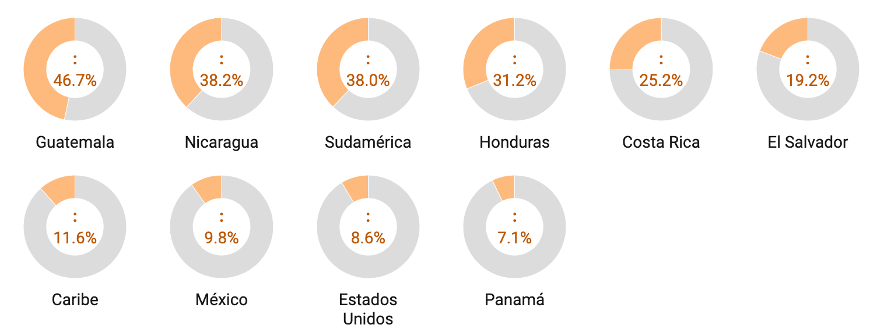
Figure 1: Weight of Agro exports in relation to the value of total exports. Source: Own calculations with data from Harvard University's Atlas of Economic Complexity.
The numbers show us a vulnerable region; which means that in order to face these risks, measures must be taken to generate resilience and mitigate the impacts. The way to do this is through climate-resilient agricultural practices. This includes techniques such as crop rotation, the use of drought or flood resistant varieties, crop diversification, or implementation of soil conservation practices.
It is also an issue of technological change, such as incorporating precision technologies, such as geographic information systems (GIS), remote sensing, drones, or artificial intelligence, that can help farmers make more accurate decisions about when and where to plant, and how to manage their crops to maximize water and nutrient efficiency.
Infrastructure plays a relevant role in this issue, particularly irrigation infrastructure. The design and implementation of efficient irrigation systems can minimize water wastage and ensure that crops receive sufficient irrigation during periods of drought. Equally important is the financial system and access to agricultural insurance. Agricultural insurance can provide a financial cushion for farmers when they face losses due to extreme weather events.
And as with any complex challenge that requires transformation, human capital formation and knowledge management are key elements. Training and education on climate change and how to adapt to it is essential for both farmers and stakeholders associated with the sector. This education can include information on new farming techniques, technologies and strategies to manage climate risk.
Governments undoubtedly play a crucial role in this process, as they are responsible for creating the business and investment environment that encourages the adoption of sustainable and climate-resilient agricultural practices. They also have a responsibility to promote the use of new technologies and ensure simple and efficient access to insurance and credit.
Finally, the incentive to adapt is clear: to keep the economy functioning. S&P Global estimates that up to 90% of the Gross Domestic Product in the region is exposed to climate risks. Starting to build more resilient sectors, in the face of this disruptive climate context, requires collective dynamics that guarantee the participation of all actors in society. Understanding that the issue is not merely environmental or climatic, the objective is to guarantee business continuity in an environment of global risks, will the region be able to make the necessary changes in time?