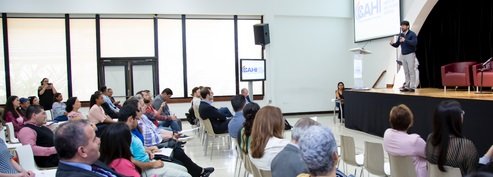
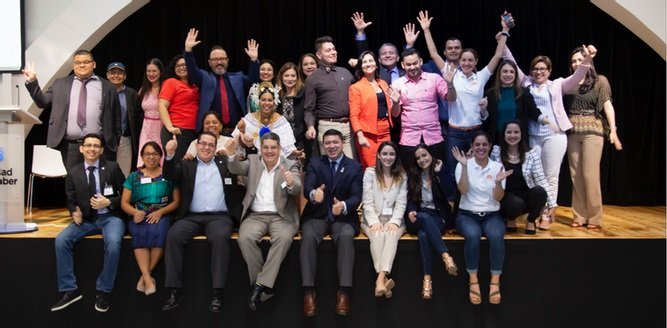
- More than a hundred people met last February 14 at the City of Knowledge Convention Center, brought together by their particular interest in human welfare and progress towards achieving the much-needed and long-awaited Health Equity in Central America.
The Annual Conference of the Central American Healthcare Initiative (CAHI) is already a point of reference in the region, being a meeting place that each year brings together important leaders and experts in the area of health, to share perspectives, learnings, and renew their commitment to improving access to health care, especially for vulnerable populations.
This 5th CAHI Conference was entitled Equity in Health: the Transformative Power of Agents of Social Change, thus placing its emphasis on the capacity of people to generate improvements in their own communities and environments. It is understandable then why this meeting produced so much enthusiasm among those present.
The exchange took place between social entrepreneurs, medical specialists, health center managers, international experts, academics, authorities and citizens. The range of people present is an example of CAHI's innovative approach, which, in addition to promoting specialized leadership and efficient management of health projects, encourages cooperation among all sectors of society as a key to addressing and overcoming collective challenges.
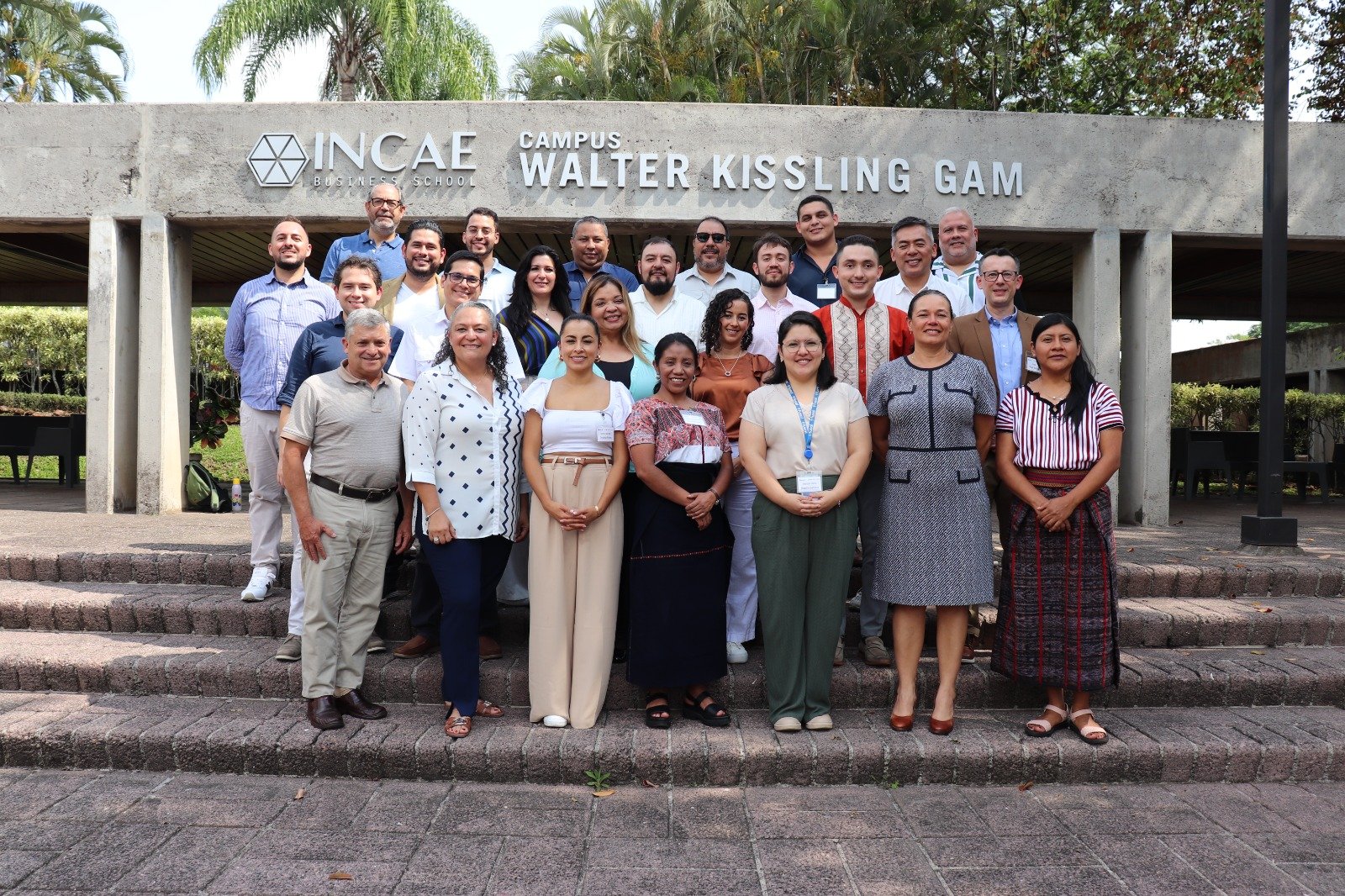
The CAHI Fellows program, which graduated its 5th generation at this event, is developed in partnership with INCAE Business School, to provide a high-level training program in health management to medical and community leaders throughout Central America. Participants receive a full scholarship for their participation in an intense 8-month program, within which they develop and refine their ideas or initiatives to generate a positive impact on health care and services, cooperating with a more equitable access to health.
THE FIRST MOMENTS OF THE CONFERENCE
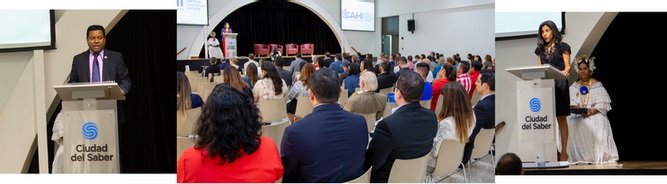
Shivaugn Ahern, Executive Director of CAHI, was in charge of welcoming the participants and emphasized the importance of cooperative work and coordinated efforts among all stakeholders to advance health equity in the region.
Ahern said: "Our goal is to continue to support the CAHI Fellows network to continue to share their learning and achievements for health equity.
Robert Jeffe, Founder and President of CAHI, confirmed this message by addressing the audience, arguing that one of the keys to this process is the high level of qualification of health leaders. With proper training, the greatest impact is guaranteed.
Both took the opportunity to thank the INCAE Business School for the design and implementation of the health management training program, specially developed for all generations of CAHI Fellows.
High-level representatives and distinguished guests from the Panamanian Social Security Fund and the Ministry of Health joined in the welcome, with words full of pride for the impact that CAHI Fellows are achieving in the region and the relevant participation of all sectors.
FIRST PANEL
HEALTH EQUITY IN VULNERABLE CENTRAL AMERICAN COMMUNITIES: WHAT HAVE WE LEARNED?
The first specialized presentation was given by Dr. Lisa Adams, Associate Provost for Global Health and Director of the Center for Health Equity at Dartmouth College. Dr. Adams offered a macro perspective on health equity, which allowed us to understand the context and general trends within which the projects promoted by CAHI are inserted.
Dr. Adams stated that equity in health is a central element of development, which, if not achieved, deepens the impact of populations that systematically experience difficulties in exercising their rights and accessing services and medical care because of their race, ethnic group, religion, socioeconomic status, gender, age or mental state, sexual orientation, gender identity, geographic location or other characteristics.
As key elements to advance towards health equity, he mentioned: the promotion of leadership at all levels of the health system; established resilient institutions; decisions based on scientific evidence; the equitable design of the programs to be implemented; the focus on providing care at the community level; and finally, the collaboration of all sectors.
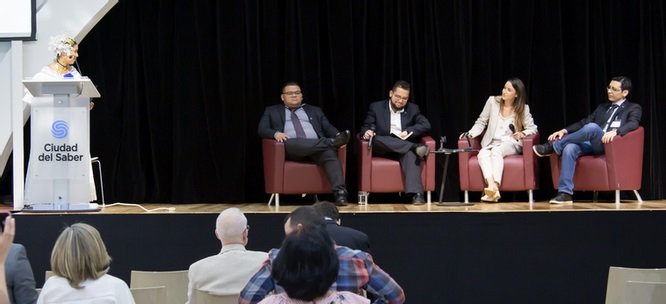
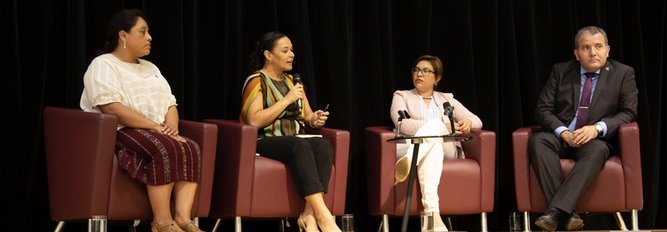
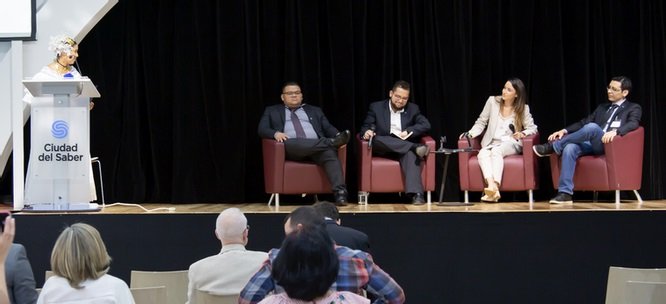
The first CAHI Fellows panel, moderated by Andrea Prado PhD, Associate Professor at INCAE Business School, was based on this general vision. In this panel, which addressed the lessons learned from working with vulnerable communities in Central America, participated doctors Marylín Hernández(Ph7 Clinic in Honduras), Waleska López Canú(Wuqu' Kawoq, Guatemala), and Alcibíades Batista (Regional Director in Chiriquí for MINSA, Panama).
He highlighted the way in which these leaders took social problems and transformed them into opportunities for transformation, opening diverse options for empowerment and the development of new learning in their communities, which guarantees the sustainability of their projects and a growing impact.
VISIT TO THE STANDS
GETTING TO KNOW THE PROJECTS OF THE CAHI FELLOWS
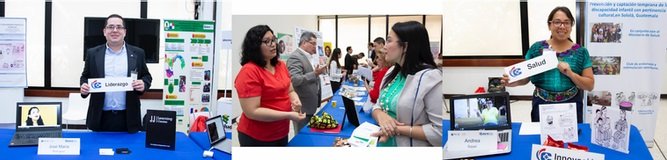
The break that followed this interesting dialogue allowed all those present to walk around the exhibition area, where the 19 CAHI Fellows of the fifth generation had the opportunity to share their projects and experiences.
- Silvana Alaniz, Vivian Pellas Hospital in Managua, Nicaragua.
- Oscar Castaneda Campos, from the Nueva Concepción Hospital in El Salvador, El Salvador.
- Rafael De Gracia, from the Miguel Arcángel Hospital in San Miguelito, Panama.
- Mariela Delgado Mora, from Asociación 123 a Moverse in San José, Costa Rica.
- Rosalina Delgado Mora, of Asociación 123 a Moverse in San José, Costa Rica.
- Isabel Delgado Ramirez, Caja del Seguro Social, Costa Rica.
- Silvia España, from the Departmental Hospital of Totonicapán in Quetzaltenango, Guatemala.
- Sergio Flores of COMSALUD in Tegucigalpa, Honduras.
- Ingrid González, from MINSA in Panama, Panama.
- Iveth Izaguirre Sánchez, from the San/SCGG Technical Unit in Comayaguela, Honduras.
- Ricardo Jiménez Yela, PASMO Association in Guatemala, Guatemala.
- Maxbeny López Canú, of the Wuqu' Kawoq Association in Chimaltenango, Guatemala.
- Giovanna Melillo Vegas, of the National Association Against Cancer in Santiago de Veraguas, Panama.
- Thomás Meoño Martín, from the Social Security House in Cártago, Costa Rica.
- Josué Murillo, from the Manuel de Jesús Subirana Hospital in Yoro Yoro, Honduras.
- José María Rodríguez, from the MOVICÁNCER Foundation in Managua, Nicaragua.
- Edgardo Saavedra, of the Caja del Seguro Social in Panama, Panama.
- Andrea Sojuel Figueroa, of the Association of Parents and Friends of Persons with Disabilities in Santiago Atitlán, Guatemala.
- Milvia Solórzano García, from the Social Affairs Secretariat of the Municipality of Guatemala in Villa Nueva, Guatemala.
One of the most striking aspects of this exhibition was the diversity of experiences and initiatives, characterized by the exercise of leadership with high management training, attention to vulnerable or marginalized populations, collaboration between the public and private sectors, the high level of community participation and finally the cooperation within the CAHI Fellows network.
SECOND PANEL
WORKING TOGETHER TO BRING HEALTH CARE TO THOSE WHO NEED IT MOST
Dr. Nathan Bertelsen, Associate Professor, Department of Medicine, New York University, who is also a member of the CAHI Board of Directors, spoke about the relevance and impact of the network of health leaders being formed by the CAHI Fellows in the Central American region.
Their close and human approach highlights the values that are present in all the leaders and health professionals who have gone through the program: the recognition of the family as a core and motivating element for action, the care of the environments and resources available for the sustainability of the initiatives, and the respect for diversity in the relationships established within the network. All these elements are clearly connected to a deep collective commitment, as a characteristic of this group of graduates of the program.
Dr. Bertelsen spoke of Planetary Health, considering complex variables and global changes that generate important variations in the area of health, the manifestations and acceleration of climate change and migratory processes. Around them there is a set of imaginaries in motion, which sometimes produce the deviation of actions that could have a positive impact in the face of existing challenges; however, there are also initiatives such as CAHI, which considers the necessary emergence of an innovative leadership to face this dynamic reality.
This presentation served as the framework for the following panel, moderated by Andy Pearson M.S., who is a researcher at INCAE Business School. Allan Bejarano (Consultant, Costa Rica), Dr. Giovanna Melillo(Skin Cancer Clinic, Panama), and Dr. Sergio Flores(Red Médica Integral, Honduras) participated in this conversation.
In this dialogue, support processes and collaborative work between the public and private sectors were highlighted, as well as the need for an organized process that guarantees sustained care, an adequate flow of information and educational efforts aimed at disease prevention. On the other hand, the relationship of the health area with other community needs such as access to employment or decent work, training and the coordination of organized actions by the community was also considered.
OBSERVATIONS FOR THE FUTURE
Dr. Leonardo Cubillos, MD MPH, Senior Policy Advisor at the Center for Technology & Behavioral Health, Dartmouth College, was responsible for a final reflection on what was shared throughout the conference.
Dr. Cubillos presents five challenges, which become opportunities and together a solid vision for the future of the Central American Healthcare Initiative and the regional network of CAHI Fellows:
- Broaden and deepen the measurement of the impact of projects under development.
- Document the successes and failures to generate learning.
- Take existing public-private partnerships to a new level, to consolidate and expand them in all the countries of the region, and to integrate digital technologies into communication, research and learning processes.
- To take the learning processes to more people and more communities, in order to continue promoting social leadership with broad management skills.
- Consolidate the CAHI Fellows as a collaborative learning network.
Thus, this important network of people and initiatives throughout Central America, as well as the practices and lessons learned that are shared to strengthen social and collaborative leadership, have generated a movement that has been consolidating in recent years, with the participation of the public, private and civil society sectors.
This is a network of individual wills that positively affect the connective tissue and cooperate with the increase of health equity in the region.
Dr. Cubillos concludes with these words: "We share the responsibility and commitment to multiply this school of social leadership, to unite our efforts so that the knowledge that the communities have through the projects facilitates the formation of new profiles. It is about turning this seedbed into a great school of leaders for Central America."