Interview with Prof. Héctor Martínez
Héctor Martínez is an assistant professor at INCAE on various topics: Organizational Behavior, HR, Coaching, Organizational Change, among others. He [...]
Héctor Martínez is an assistant professor at INCAE on various topics: Organizational Behavior, HR, Coaching, Organizational Change, among others. He himself affirms that these are topics that he is passionate about and about which he is always researching and dialoguing.
He is a graduate of Key Western Reserve University, with the mentoring of Richard Boyatzis, a great expert on Emotional Intelligence and Change in People, co-author of several books with Daniel Goleman.
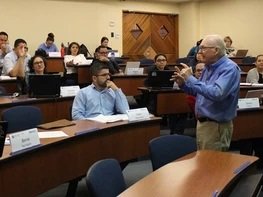
We were fortunate to attend his classes and in one of the moments in which the participants develop an interesting exercise, we asked him for a few minutes to do this interview.
How did you come to the CAHI Fellows program?
Héctor: I was invited by the INCAE Business School, specifically through Professor Andrea Prado. She told me about the objectives of the program, the wonderful projects that the CAHI Fellows bring and she approached me about the possibility of being an advisor or mentor for them. My experience from the first moment was very special, because in my experience this has been like watering with water a land that was waiting for that to generate plants at a great speed. Because the CAHI Fellows are doing this, literally, changing people's lives. In this process, it's amazing how they make the most of the information we give them, and how they immediately identify its application in their initiatives and their approaches.
For me it has been very exciting and energizing to share with them, I have had very powerful contacts with these people, authentic encounters. The courses I teach, which we have called People Management, have to do with ways of living organizations, of generating links with other people, which is fundamental because at the end of the day organizations should be vehicles for us to realize our dreams. Sometimes, due to designs, dynamics, problems in that encounter between people, we have deficiencies, so my approach is to help them and provide them with another perspective and new experiences so that they can transform their dynamics and address the realities they face.
What do you bring to the CAHI Fellows Program from your classes?
Hector: First of all, I try to generate self-knowledge. I have seen this group initially extremely focused on their tasks, on fulfilling the requirements that can be overwhelming, I have perceived that some rivalry can appear among them, because they are all successful in what they do and want to achieve goals, this is quite natural. My view then is that they need time to get to know each other, to develop their relationships and build networks. My intention is to remind them that these people around them are important to connect with, I also want to show them how to do it in an efficient and direct way.
With me they have experiences in that direction, such as a simulation that requires a particular type of leadership, some coaching questions to guide them to have good conversations. What they experience in these sessions allows them to visualize a way to generate transparent and positive relationships, which is what I try to leave to the CAHI Fellows.
What impact do you think, along these lines, they can have in Central America?
Héctor: Imagine what our region would be like if all people found jobs or organizations where they could fulfill their life's desires, where they could feel enthusiasm to do what they do. If everyone had that possibility, if our region was an engine of innovation, of energy, of creativity, I am sure we would change instantly. For me it is about finding "my ideal self", that is why my energy is focused on my students or the people I interact with finding this and going to offer that opportunity to others, that they have the dignity and possibility to find ways to realize their dreams and change their future.
To me that's the impact that CAHI Fellows can have through their interactions. They are an example of that too, because if they get to generate the impact they hope for with their projects, it inspires others to think they can do it too. This is my vision and I am extremely honored to be a part of that.
CAHI Fellows often face very complicated social problems and situations . How can they cope with them and maintain this perspective of realizing their vision of the "ideal self"?
Hector: If we look back, we get discouraged. After all, our whole region has endless queues of bad things that have been happening. But if we focus only on the past, there is no future. We have to make a point and affirm that tomorrow has to be better, because there is no other option. This does not imply to stop analyzing what happened before, but it does demand that we consider that tomorrow has to be better than today, and today better than yesterday. We are the ones who are living in the now and if we do not have that hope and desire, things become very difficult. We need to have hope, this is something very important.
From a more technical approach, what would you say are the most significant aspects that CAHI Fellows learn in your sessions?
Hector: I can identify three very specific issues: the first is that performance is explained by people, by the dynamics we have in the group and by our designs. In many cases this might seem obvious, but these are things that sometimes managers do not sit down to think about, sometimes they do not think about how to structure these things; on the contrary, it is said that what is needed are more leaders, but this is not necessarily true. If we can make designs that facilitate teamwork, if we structure processes to fulfill our desires and visions, to facilitate people's performance, then there is no need for more leaders.
The second aspect is the coaching process, the questions I provided them with, which help participants to have conversations that influence, that generate empathy in others, that facilitate connection, that build relationships more quickly, more efficiently, which will allow them to convince the people they need to convince to carry out their projects.
The third element is psychological safety, which is one of the variables or factors correlated with team success. This is vital, because if you have the opportunity to find information about problems before they become explosive, psychological safety is the key.
Amy Benson, who develops the topic of psychological safety, conducted her studies with nurses. Imagine a nurse checking a prescription at 3 a.m. and finding a mistake, at which point she has to decide whether or not to call the doctor. That call may be well received with a thank you and a correction of the mistake, or with an adverse reaction and annoyance at having to wake up at that time of the night. Based on this experience, the nurse will establish a course of action when faced with the identification of errors: to report them or not to report them. Let's think then what repercussions this may have on lives or deaths in a hospital: this is a context of psychological safety and it is something so subtle that sometimes it is not done consciously, or we generate tension because as leaders or administrators we demand perfection and zero tolerance for error, which is something that scares anyone.