December 10, 2019. Every December 9 is commemorated the International Anti-Corruption Day, established by the General Assembly of the United Nations, with the purpose of raising awareness of the negative impact that this problem brings in the understanding that corruption is one of the obstacles to economic and social growth that weakens democratic institutions, exacerbates impunity and causes inequalities in society.
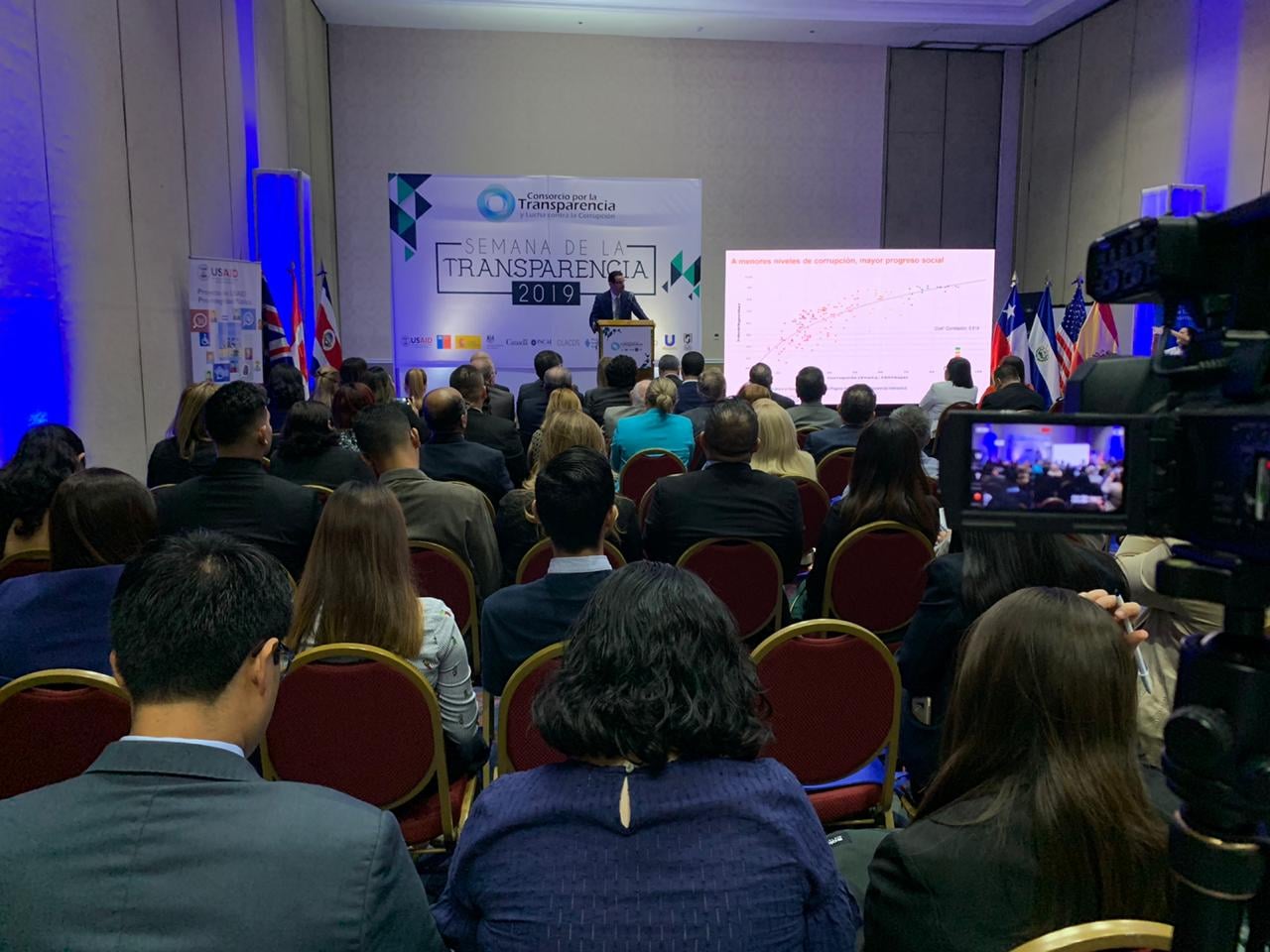
As part of this celebration, the Seattle International Foundation (SIF) and the Latin American Center for Competitiveness and Sustainable Development (CLACDS) of INCAE Business School held a Conference on Corruption and Economic Development on December 10, kicking off the 2019 Transparency Week organized by the Consortium for Transparency and Fight against Corruption.
Throughout the day, the causes and consequences of corruption on economic development and social progress were discussed and good practices in the public and private sectors that have achieved profound changes in the fight against corruption in the region were showcased.
Octavio Martínez, Director of CLACDS/INCAE, described the scourge of corruption in our countries and the negative impact it has on the capacity of the State to generate quality of life for its citizens. He also presented the main causes of the phenomenon and some general recommendations on how to attack it.
Carolina Muñoz, Partner Dentons Muñoz, commented that the adoption of an anti-bribery management system and a culture of compliance by companies implies a commitment to transparency and ethical policies, which fosters trust in their business not only towards their business partners, investors, clients and suppliers, but also with respect to their personnel.
Luis Cuenca, Professor at INCAE, defined corruption as a systemic problem that develops where institutions are not well designed and it is necessary to build an efficient and transparent State, in which much collaboration is required from the private sector; mainly in two ways: learning efficient management practices and support in the forensic study.
"Political instability and corruption in Latin America have accentuated poverty in the region. Latin America's development agenda must necessarily include actions to mitigate these ills. CLACDS has initiated a research program that aims to develop teaching materials on anti-corruption measures that are used in various courses in the master's degree programs at INCAE," commented Niels Ketelhöhn, Professor at INCAE.
The event was attended by Claudia Umaña, President of Fundación DTJ, Octavio Martínez, Director of CLACDS-INCAE; Luis Cuenca and Niels Ketelhöhn, Professors at INCAE; and Carolina Muñoz, Partner Dentons Muñoz.
For the second consecutive year, the Seattle International Foundation (SIF) has partnered with the Latin American Center for Competitiveness and Sustainable Development (CLACDS) of INCAE Business School to promote spaces to address ethics and transparency in the Central American region. This same event was held in Tegucigalpa, Honduras in October.
For more information, please contact Mauren Esquivel at mauren.esquivel@incae.du.