According to the WHOthe COVID-19 crisis has been accompanied by the phenomenon of infodemia; that is, a massive amount of information (some correct, some not) on a specific topic, which makes it difficult for people to find reliable and trustworthy sources when they need it. This generation and dissemination of information in a context in which millions of people can produce and share content from their cell phones or computers can reach levels of magnitude that are difficult to understand; such as, for example, that in 2020, in a minute, an average of on average 500 hours of video on Youtube; 347,222 stories on Instagram; and 42 million messages on Whatsapp. Never in the history of mankind have we had this ability to communicate.
But as the WHO points out, in the context of a pandemic, this capacity has become a particularly dangerous factor, as fake news has multiplied. fake news and conspiracy theories and conspiracy theories about COVID-19, its effects or vaccination have multiplied. From linking the virus to mobile phone mobile telephonepromoting false remedies or spreading fear about vaccination. This type of false information knows no borders and affects all countries; and as mentioned in the previous blog, it can affect the fulfillment of vaccination goals. vaccination goalsso necessary to get out of the crisis.
Of course, fake news is not new, it has been tracked and studied as the social phenomenon that it is for years. In 2018, it had already been analyzed that the fake news moves and are shared faster than real news, in fact they are 70% more likely to be shared than real news; being people the main responsible, and not armies of bots or computer programs.
Behind this phenomenon of sharing fake news are the so called cognitive biaseswhich, as Nobel laureate Daniel Kahnemanare irrational mental shortcuts that influence our decisions, where our beliefs, our reference groups, and our experiences count. And while it is complicated to measure these cognitive biases, Facebook and the Economist Intelligence Unit, as part of their initiative to measure the internet inclusivenessIn a survey of internet users in 120 countries, Facebook and the Economist Intelligence Unit, as part of their initiative to measure internet inclusiveness, asked internet users in 120 countries how much trust they have in information shared on social networks from other users. This allows us to discern the risk of countries being more affected than others by fake news.
Thus, Nigeria and Pakistan stand out, where 50% of Internet users widely believe in the content shared on social networks, being the most credulous of the countries evaluated; in contrast, the most skeptical are Bulgaria and New Zealand with less than 13% of users who widely believe the information shared on social networks by other users.
In the region, Costa Rica with 18% and Panama with 20% are the countries with the lowest percentage of internet users who widely trust social network content shared by other users; in contrast, Honduras with 32% and Nicaragua with 34% are the countries with the highest levels of trust. If we compare with the United States, as a reference, the level of trust in this content is 41.8%.
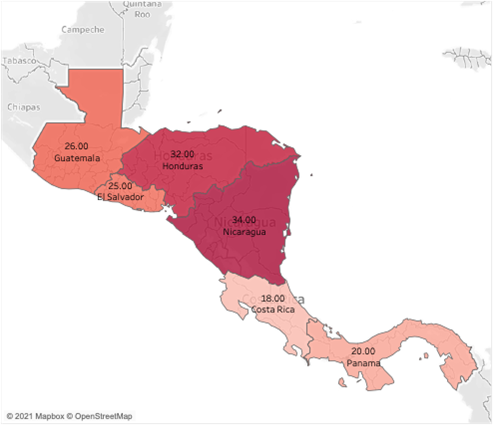
Map 1. Percentage of internet users who largely trust social network content shared by other users. Source: Prepared by INCAE with data from Inclusive Internet Index.
Faced with this phenomenon, different efforts have been made by organizations, governments, companies, the media and civil society to counteract disinformation with filters and mechanisms to verify information. And while these efforts are necessary, it has been analyzed that quality education is the best filter to deactivate fake news. In the region, this becomes clear when contrasting the average years of education of internet users, and it is found that the lower the number of years of education, the higher the percentage of users who widely trust the contents of social networks, making them more likely to share fake news.
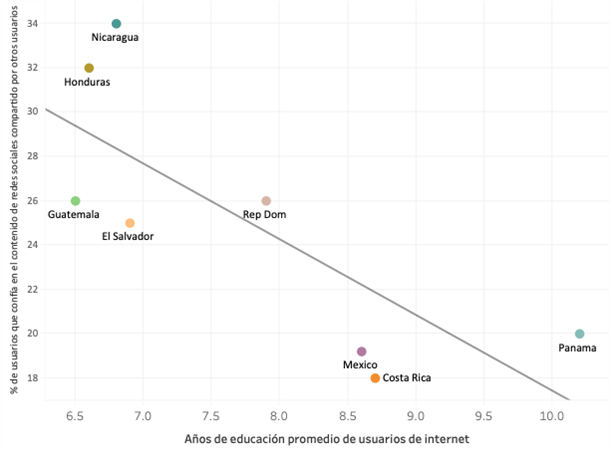
Relationship between trust in social network content shared by other users and users' average years of education. Source: Prepared by INCAE with data from Inclusive Internet Index.
Finally, the pandemic has reminded us that this phenomenon must be given the importance it deserves, because it has not only sown doubts in medicine and science, but has also cost lives. has also cost lives.. And it is clear that this phenomenon will continue to be a risk factor for all social dynamics, affecting the social contract and threatening to destabilize democracy. democracydemocracy, public public debateour freedoms, and the functioning of our societies. So we must begin to take it seriously, and address it in a coordinated manner with governments, media, businesses, civil society and a lot of individual responsibility.