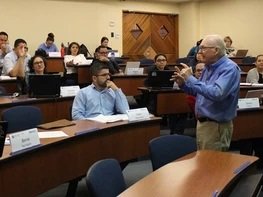
Interview with Prof. Roberto Mendoza
Roberto Mendoza has been with the INCAE Business School for 36 years. He is a professor in three areas: financial accounting, management and managerial control. He is a graduate of cont [...]
Roberto Mendoza has been with the INCAE Business School for 36 years. He teaches in three areas: financial accounting, management and management control. A graduate in public accounting, he worked for several years in the private sector in Nicaragua. He has also worked as a business consultant in Central America. He holds a Master's degree in Business Administration from INCAE. He has been a guest lecturer at the University of Miami and Florida International University.
Within his demanding schedule, he opened up a few minutes for us to ask him a few questions.
How did you come to teach in the CAHI Fellows Program?
Roberto: I have been teaching people related to health for several years. First in a master's degree for physicians, which was an experience that generated my interest in analyzing the relevance of the tools I know in institutions such as hospitals or health centers. Later, when INCAE developed a management program for hospitals, I had the opportunity to write a couple of cases in Guatemala, related to the National Cancer Institute and the services they offered, as well as their budget management.
With that experience as a base, I began to participate in the CAHI Fellows program, specifically in topics related to the approach to cost management of projects or organizations in the health sector, so that participants can make better decisions.
How have you perceived the evolution of the groups in the CAHI Fellows program?
Roberto: The compositions of these groups are always different, it is impossible to compare one generation with another. But what I see is that they are more and more interested in developing their projects and taking them to another level, I also perceive interest in tackling the administrative area.
What do you think you leave behind in the CAHI Fellows?
Roberto: I try to transmit responsibility, because resources should be used in different areas such as education, so that what has been allocated to health should be managed with more awareness on how to make budgets, how to be more efficient in spending and how to maintain a quality service.
It is important to understand cost systems and how they can affect efficiency, and can even have an important impact on the possibility of finding more resources for project development or management, because if the expenditure is not properly justified or recorded, it is unfeasible to obtain more. This is a tool for evaluating results and accountability with transparency.
What is your view of CAHI Fellows once they go through your class?
Roberto: I think it is important for them to continue preparing. This is a beginning, it is sowing a seed, but we must continue to fertilize and add water, impart new knowledge, develop more advanced levels of this program, so that the development is optimal.