Transparency International recently published the update of its global indicator on the state of corruption in the world (ICP); an index that ranks 180 countries and territories according to the perception of experts and businessmen, and ranges from 0 to 100 points, where 0 is high corruption and 100 is low corruption. This year the countries with the highest scores are Denmark, New Zealand, Finland, Singapore, Sweden and Switzerland; while the countries with the highest levels of corruption are Venezuela, Yemen, Syria, Somalia and South Sudan.
In Latin America the best positioned countries are Uruguay, Chile and Costa Rica, occupying positions 21, 25 and 42 respectively; at the bottom of the table, or the countries with the highest levels of corruption are Venezuela, Nicaragua and Honduras with positions 176, 159 and 157 out of 180 countries. Compared to last year, the region has practically stagnated, without major improvements in the fight against corruption.
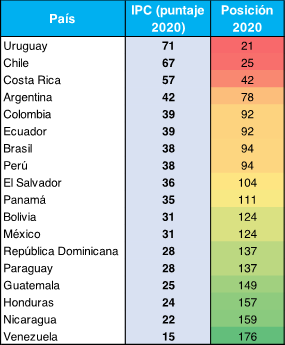
Table 1: ICP positions for Latin America. Source: Prepared by the authors with data from Transparency International.
In normal times, the publication of these results would be sufficient, and would provide quantitative support for an analysis of the impact of corruption on the efficiency of the economy, or the stability of institutions, or any other issue related to this practice of abuse of power for personal gain, as defined by Transparency International. But in a world hit by the COVID-19 pandemic, in which we count more than 100 million infected and more than 2 million dead, and that the second or third wave continues to wreak havoc in most countries, the issue of corruption also becomes an issue of COVID-19 and the capacity of countries to deal with a complex and long-lasting problem such as the pandemic.
Transparency International's team of researchers finds 3 factors where corruption has affected countries' performance in addressing the pandemic:
- Corruption diverts funds from essential services such as healthcare, leaving countries around the world vulnerable and unprepared to deal with the public health crisis.
- Lack of transparency in resource allocation, a practice positively associated with corruption, weakens the efficiency of crisis responses.
- Countries that perform poorly in controlling corruption tend to violate human rights and democratic norms in their handling of the COVID-19 pandemic.
These factors may have an impact on the indicators we have available on the management of the pandemic, such as the incidence rate (cumulative cases per 1000 population), and lethality (percentage of deaths due to COVID-19 positive cases). Cross-referencing the corruption index data with the COVID-19 health indicator data for the 180 countries evaluated, we find that if we divide the countries by corruption levels (Figure 1), we find that the countries with the highest corruption (on average 24.05 PCI points) have a COVID-19 incidence rate per 1000 population of only 4.85; the countries in the group with medium-high levels of corruption (on average 38.8 PCI points) have an incidence rate of 16.09 per 1000 population. In contrast, countries with better levels of transparency and less corruption report more cases of COVID-19 incidence with 30.85 per 1000 for countries with medium-low levels (55.7 PCI points on average), and 24.91 per 1000 for countries with the lowest corruption (on average 78.28 PCI points).
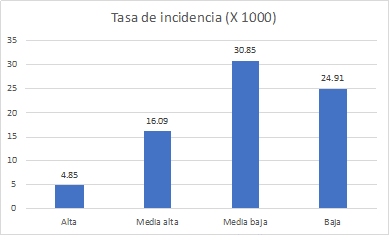
Graph 1: Incidence of COVID-19 by level of corruption. Source: Own calculations with data from Transparency International and Johns Hopkins University.
If we contrast lethality (total COVID-19 deaths with respect to the total number of reported cases) with the levels of corruption. It is found that COVID-19 lethality decreases in accordance with the reduction in corruption. Countries with high levels of corruption report almost twice as much lethality as countries with lower levels of corruption (Figure 2). These comparisons are, of course, subject to the quality of the data that Johns Hopkins University has access to and reports, so these are the official data, which for some countries does not necessarily mean the real data. However, it is contrasting that for a threat that requires mobilizing resources, making public purchases, and bringing a public service to a large population, it is the least transparent and most corrupt countries that report the lowest incidence of cases and the highest lethality.
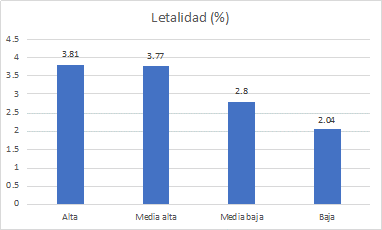
Graph 2: COVID-19 lethality by level of corruption. Source: Own calculations with data from Transparency International and Johns Hopkins University.
As this is an event that is happening right now, it is necessary to continue collecting information and to make an analysis at the end of the event to finish evaluating these relationships, including the vaccination process. But as mentioned by Transparency International, the characteristics of the countries that will have the best management of the pandemic are those that have policies of transparency and accountability, that have clear and efficient public procurement systems, with strong mechanisms to audit and supervise the institutions and their decisions during the emergency, as well as to protect the rights of citizens and maintain a balance between sectors and powers within the social contract.
In concrete terms, it is now very clear that corruption costs lives; and that any resilience building to address future emergencies must have solid transparency and accountability mechanisms, conditions that in the region we still have much to improve.