The growing popularity of Artificial Intelligence applications are a sign that the technological change of the 4th industrial revolution is accelerating. As a region it is time to decide how we are going to enter this technological shift.
The economic development and social progress of civilization has been driven by technological change. The Iron Age, the Bronze Age, the Green Revolution, the First Industrial Revolution (steam), the Second Industrial Revolution (electricity), the Third Industrial Revolution (electronics), are stages in history that changed society and the capabilities of individuals. Today, we are in the digital era, or the 4th industrial revolution.
Of course, adopting these technologies of the 4th industrial revolution goes beyond the ability to access them. An effective technological transformation process requires a strategy; it is not just about buying the technology, it is about adapting the non-digital context to these new possibilities. In other words, a computer can be used only as a typewriter, or can its full potential be used to generate added value?
On the fourth industrial revolution
There are two characteristics of the fourth industrial revolution that make it different from previous ones. First, change is accelerated; for example, the ChatGPT application, an Artificial Intelligence (AI) chat created by OpenAI obtained 100 million active users in January of this year alone, according to UBS, marking a milestone in the history of applications. Or that during the pandemic, telemedicine advanced in 2 weeks what had been achieved in 10 years according to McKinsey.
Second, it erases the barriers between the physical and the digital, affecting multiple industries at the same time. Thus we have AI applications reviewing contracts and doing the work of lawyers; generating savings of millions of dollars. Meanwhile, in medicine, virtual reality and augmented reality instruments are already being applied to help surgeons perform more accurate and less risky surgical procedures, impacting people's health.
If we ask ChatGPT about the main technologies driving this revolution he would mention Artificial intelligence (AI) and machine learning; robotics and automation; internet of things; 3d printing; blockchain; virtual reality and augmented reality; 5G networks; quantum computing; big data and cyber security. And I would end by saying that they are converging and transforming traditional industries, creating new opportunities and challenges.
The non-digital complements of digital transformation
To materialize technological advantages and take advantage of them in our daily lives requires a strategic approach; otherwise, we may fall into the productivity paradox. This is the phenomenon in which technological investment grows, but productivity does not increase. The paradox was present in the 19th century, during the previous industrial revolution, when companies changed their steam engines for electric motors. But they saw the impacts of their investment 30 years later, when new engineers who were experts in electric motors came to change the management and dynamics of companies.
In this sense, the adoption of new technologies must go through a strategic process, in which organizational innovations are made to take advantage of the potential of technological innovations. These organizational innovations imply changes in decision-making processes, incentive systems, information flows, contracting methods and, in general, a thorough review of administration and management processes.
A current example of these strategic challenges is telework, which during the pandemic grew to unprecedented levels. Owl Labs mentions that 56% of global companies allow telework with hybrid models; while 16% implement it permanently. But in addition, they calculate that workers were 47% more productive with the telework model.
However, despite the productive advantages, IPSOS found globally, that among leadership positions, the most senior are the least comfortable with telecommuting, only 10% see it as a permanent option. Among the youngest, the percentage rises to 28%. It seems that we will have to wait for a new generation of leaders to rise in the hierarchy of companies to maximize the productive potential of telework, as happened in the nineteenth century with the use of the electric motor.
In the region we need to define our digital strategy now
In this process of accelerated technological change, it is clear that it will not be enough to have governments and companies that promote the adoption of technological infrastructure. New regulatory frameworks and laws that consider technological innovations and their social, environmental and economic impact on the different productive sectors will be required. But at the same time, an innovative effort will be required from the productive sector to adjust its organizational models or even its business models to take advantage of new technologies.
This is urgent, as the current state of our region in terms of technology use is not the best. For example, according to the World Bank, in 2021, in Costa Rica 59.18% of those over 15 years of age made or received a digital payment; the average for the rest of the countries in our region is 65.08%. While worldwide the leader is Denmark with 100%; followed by Iceland and Germany with 99% (see figure 1). Solving these gaps requires multi-sector collaborations, but focused on the following question: Do we solve the problems of the 21st century with solutions from the 20th century? In other words, either we accelerate together with the 4th industrial revolution, or we see it materialize its potential in other countries.
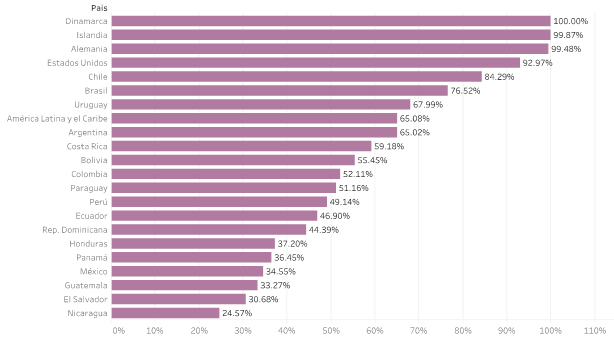
Percentage of the population aged 15 and over who made or received a digital payment in the last year. Source: Findex 2021, World Bank.