component component component--post-content post-content
  • Latin America maintains a 4-year trend of stagnation in the Social Progress Index; and in 7 out of 12 components it fell backward with respect to the previous year.
    In Costa Rica, the basic education component deteriorated and now occupies 62nd place out of 169 countries, although in social progress it maintains its second place in Latin America.
  • Latin America and the Caribbean (69.00 points) maintains a trend of stagnation that began in 2019 where it had 69.19 points. The effects of the pandemic and the international context continue to limit the region's progress.
  • Compared to the previous year, the region showed deterioration in 7 of the 12 components that measure social progress: Nutrition and Basic Health Care, Housing, Access to Basic Knowledge, Personal Rights, Inclusion, Personal Freedom and Choice, and Access to Higher Education.
  • The Social Progress Index 2022 uses 60 social and environmental indicators to measure the level of collective well-being among 169 countries. The findings highlight that, overall, the world improved 0.37 points over last year; although 52 countries, 6 of them from Latin America saw a decrease in social progress.
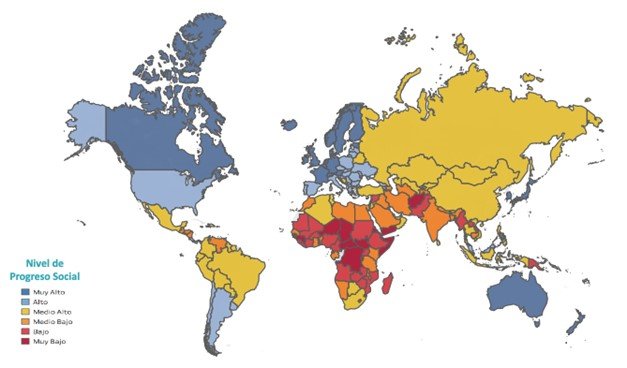
  • Norway (90.74 points) ranks first in the 2022 Social Progress Index, while South Sudan (30.65 points) again ranks last out of 169 countries. The United States (84.65 points), the eighth largest economy in the world by GDP per capita, ranks 25th in social progress, being the country of the group of 7, with the lowest score in the IPS; and with a negative trend.
  • In Latin America and the Caribbean, Chile (80.78 points) in position 36 worldwide is the best in the region; followed by Costa Rica (80.65 points) in position 37; and Uruguay (80.27 points) in position 38 out of 169 countries. The countries with the lowest scores in the region are Haiti (45.42 points) in position 157; and Venezuela (58.62 points) in position 114.
  • The largest Latin American economies such as Argentina (78.64 points) in position 41, Brazil (71.29 points) in position 62, Mexico (70.84 points) in position 66, and Colombia (69.83 points) in position 70, remain practically stagnant with respect to the previous year.
  • Panama, the Latin American economy with the highest level of per capita income adjusted for purchasing parity ($28,837) scores 74.02 points. But it has lost positions since 2011, moving from 49th to 56th place in 2022.

Results for Costa Rica

  • Costa Rica repeats in second place in Latin America with a high level of social progress. With respect to the 12 components of the IPS, its highest scores are in Water and Sanitation (95.39 points) position 19; and Personal Rights (95.35 points) position 14.
  • In contrast, the lowest scores are found in Access to Higher Education (58.95 points) position 60, and Personal Safety (64.14 points) position 75.
  • The indicators with the lowest performance are Interpersonal violence (position 134), Traffic accidents (position 102), Population with secondary education (position 95), and Low vegetable consumption (position 95).
  • The indicators with the most outstanding performance by overall position are Primary education enrollment (position 8), Satisfaction with water quality (position 15), Political rights (position 12), and Equity in access to power (position 12).
  • Compared to the previous year, Costa Rica lost points in Access to Basic Knowledge, being the second country in the region where access to quality education deteriorated the most; and it has lost 7 positions compared to 2011.
  • The Personal Freedom component also deteriorated due to the increase in the number of young people who neither study nor work, and the higher percentage of vulnerable employment in the country.

The non-profit organization Social Progress Imperative, a regional partner of INCAE Business School and responsible for calculating the IPS, warns about the deterioration of social progress worldwide due to the effects of the pandemic, geopolitical conflicts in Europe, economic instability and the environmental crisis.

Regarding the results for Latin America, Roberto Artavia, president of the board of directors of INCAE Business School said: "The last 11 years show a worrisome deterioration in access to quality education in 13 of 18 Latin American countries; precisely at a time when economic and social prosperity, as well as sustainability, depend more than ever on knowledge. It has been said that Latin America is a region rich in resources - and it is - but without human capital with the skills and capacities demanded by the times, we will continue to be an unfulfilled promise, instead of a source of wealth and sustainability for the planet."

Jaime García, Director of the Latin American Social Progress Index, said, "Social progress is highly related to competitiveness, attracting foreign direct investment, institutional quality, legal certainty and human capital, all of which are factors for sustained economic growth; that is why the trend in Latin America is alarming, because not only are we stagnating in social progress, but our ability to generate economic prosperity is also affected."

Map 1: Map of the Social Progress Index 2022

Map 1: Map of the Social Progress Index 2022

Learn more about the results of the Social Progress Index on our website: socialprogress.org.

More information

Jaime García Gómez
Director of the Social Progress Index for Latin America
E-mail: jgarcia@socialprogress.org
Phone: +506 24372200